

 Membership
 Riders Preferred Membership
 Shop by Vehicle
 Track Order
 Contact Us
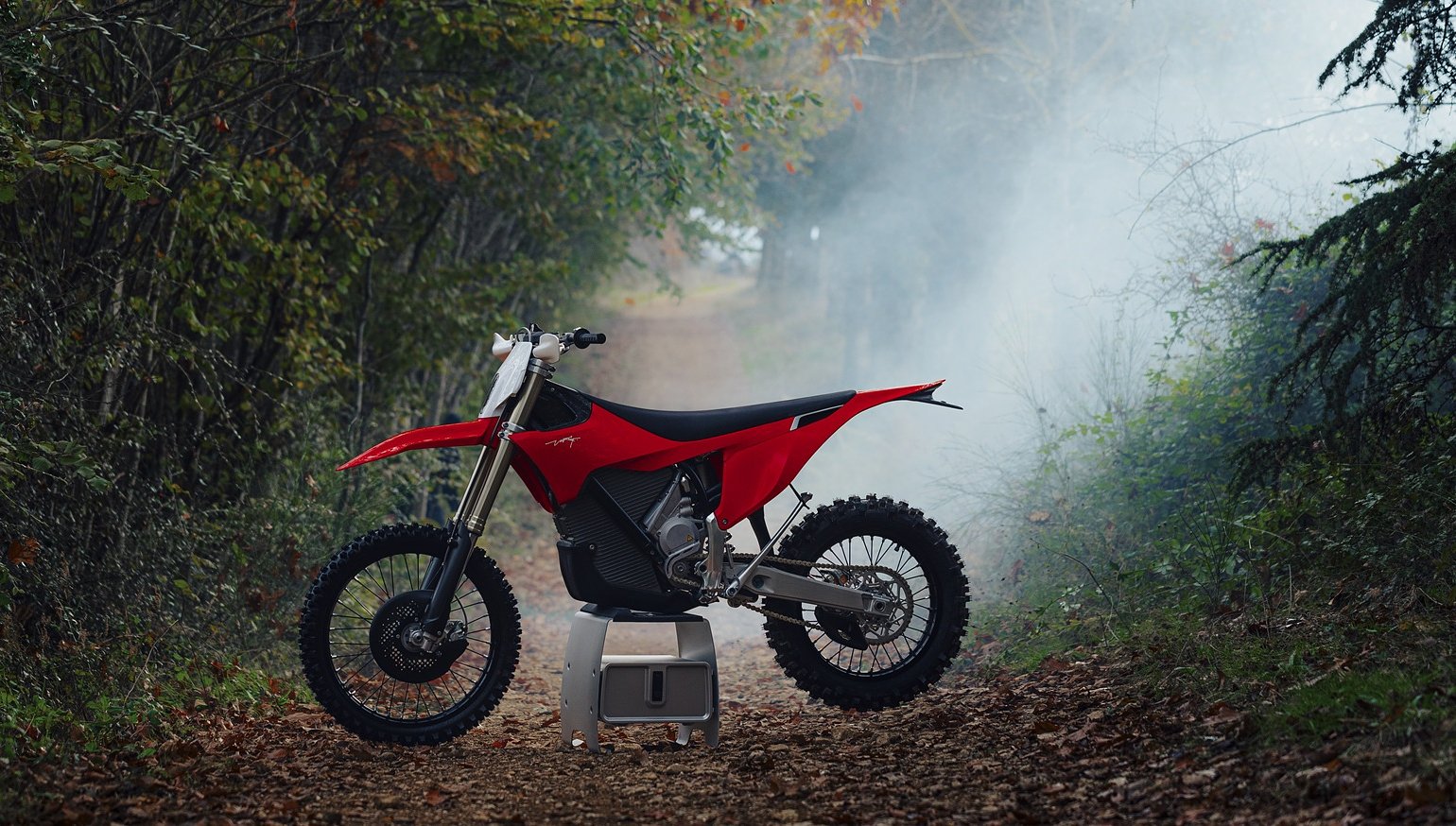
"Greg, you just gotta promise me you won't operate the bike fully submerged, like Ryan F9 did," said the Stark Future representative arranging the loan of the new EX. "You do live right next to the Potomac, after all."
"Bud, you know that is not my style," I assured him. "I'm more than a little more risk averse than Mr. F9, and I ride in a way designed to make sure you return my calls, dig?"
"Good. You don't want to know what one of those Arkenstones costs. And of course it didn't die after its initial submarine mission. No. It only fried after Ryan gave it back to us."
"No worries, man. I treat these machines as if they were mine. I'm really looking forward to having a chance to finally ride this bike."
It is possible I committed a sin of omission with that statement.
Don't misunderstand. I wasn't planning to ride underwater and I really was looking forward to testing the first Stark electric motorcycle to be able to wear a license plate and be street-legal. Stark's electric motocrossers and enduro bikes are fast becoming legendary. The rural counties that surround my home in Maryland are filled with miles and miles of unpaved farm and forest roads — some calm, some more exciting — but to ride them one has to have a street-legal vehicle. And the Stark VARG EX is street-legal.
But the part I didn't say was I was just a little scared. It's easy to understand why.
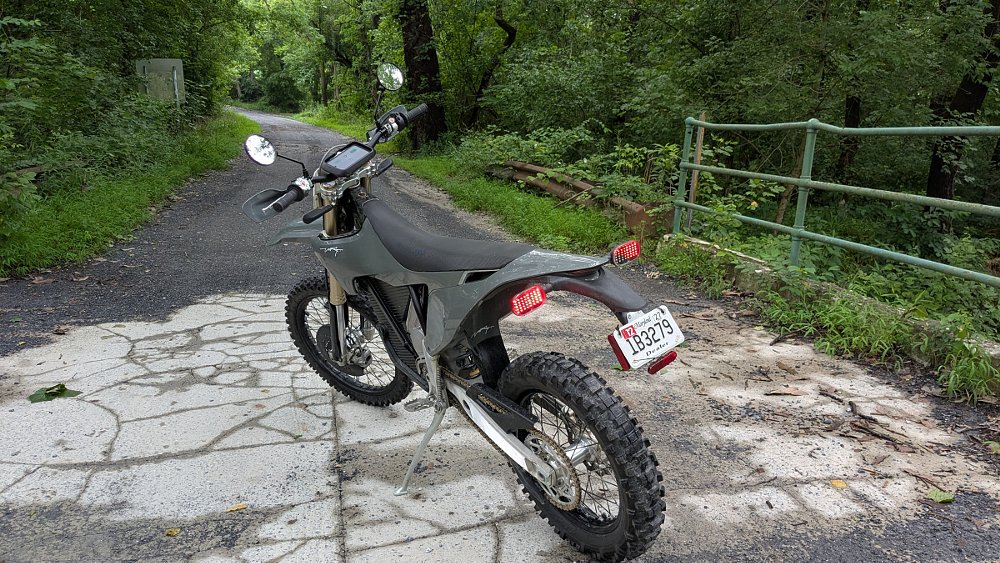
The brutal stats on the Stark VARG EX
When folks ask me about the VARG, I usually supply a brief series of examples to provide context.
- A 450 cc dirt bike you can buy at your local dealership makes a little over 40 horsepower.
- The bike that won the AMA Pro Motocross 450-class championship makes about 65 horsepower.
- The VARG makes 80.
Plus, at the time this bike was shipped to me, it had no ABS or traction control systems of any kind.
If those fact nuggets were not enough to provide one with cause for pause, I am acquainted with at least two other motorcycle writers who, when provided with the opportunity to sample the VARG, ended up having spirited discussions with gravity. Those little surprises then provided them with the opportunity to sample the quality of medical services in the location where those spirited conversations abruptly ended.
After a late start in life, I've grown into a pretty competent off-pavement rider. But I'm not spending my time in search of big air or nailing the backflip. The VARG, which was originally built to be a competition weapon, can do all of those things and many more. It has limits that are far higher than I can exploit.
Believe me, I know my limitations.
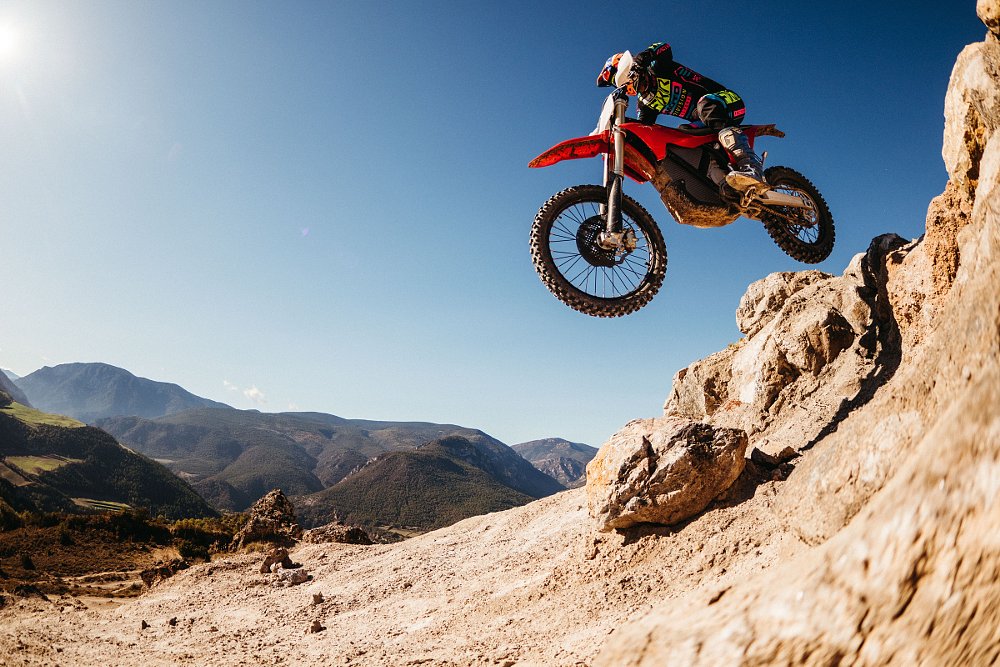
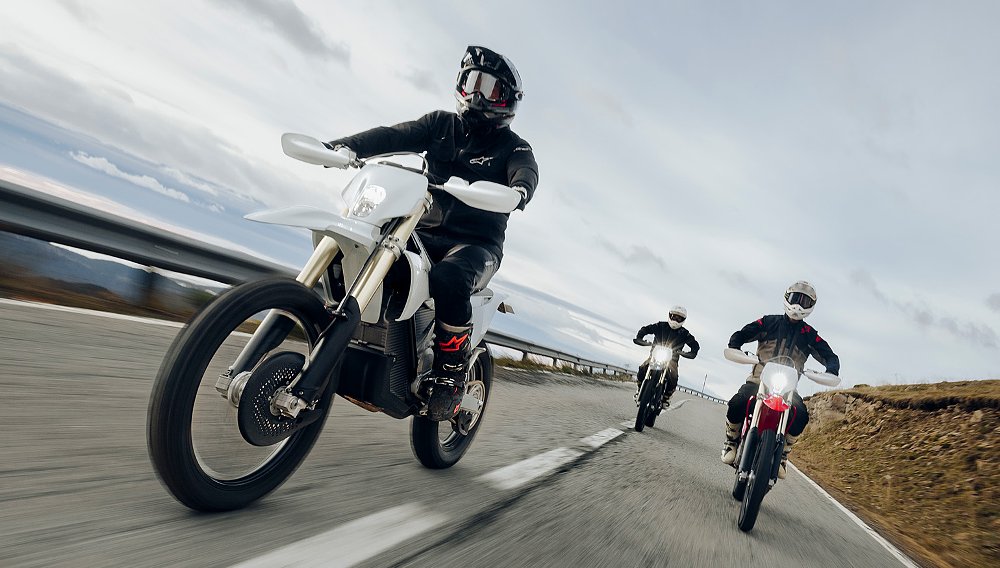
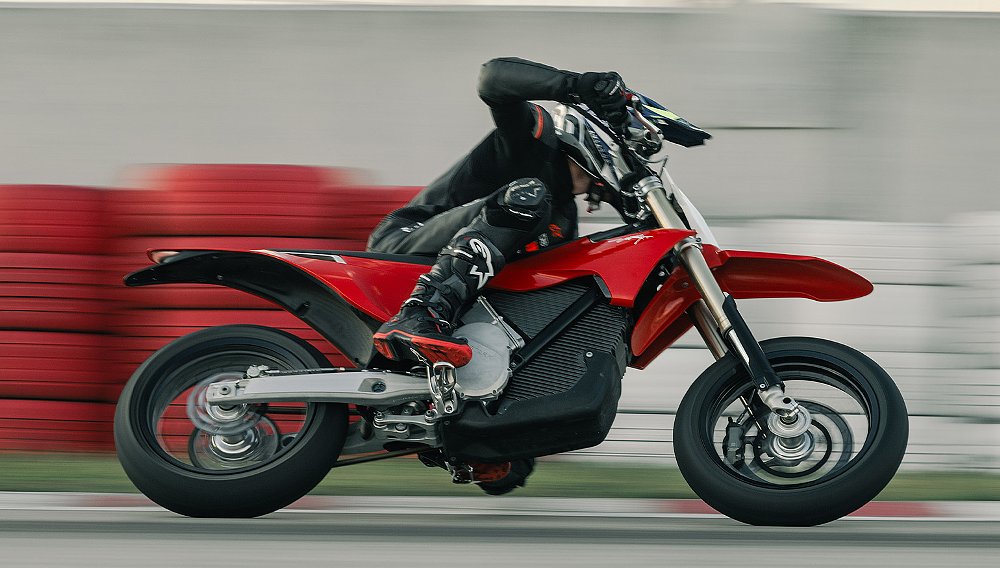
Motorcycle enthusiasts everywhere had been begging — nay, pleading — with Stark to deliver a street-legal version of the VARG. Those people's patience was eventually rewarded with not one, but two different "streetable" models: the EX, the one I was riding, which is an enduro-inspired ride, and the SM, a supermoto version designed to provide street- or track-oriented hooligan riders with everything they'd ever wanted. Common Tread's Zack Courts got an SM to review and will be along with his thoughts later. I requested an EX, which would give me a chance to take the bike into some of my favorite off-pavement play-riding areas.
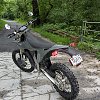
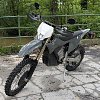
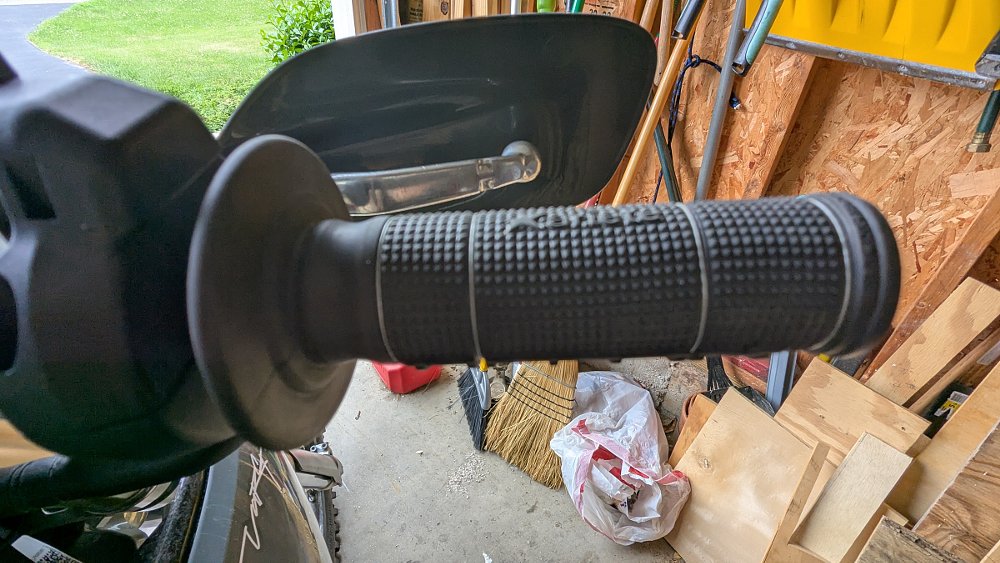
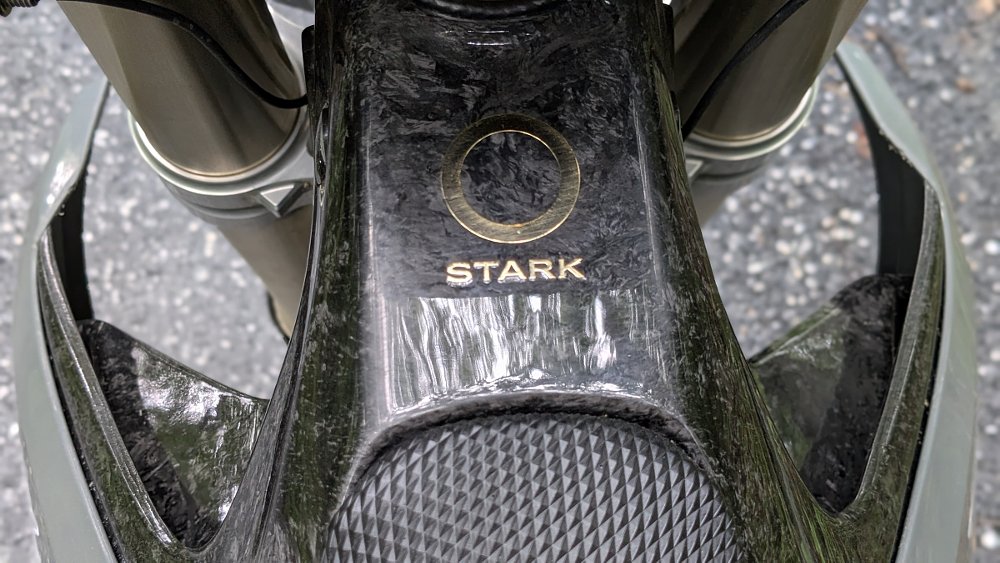
It doesn't look like Stark exerted themselves much to make the EX road-legal. A modification to the front number plate to include an LED projector headlight and integrated turn signals, and some combined rear turn signal and brake light combination fixtures were about the extent of things. The suspension, wheels, frame, and drivetrain were essentially the same as the bike people were racing. There were also other tells that my test unit was a very thinly modified racer. The handgrips were safety-wired in place and the bike was wearing a fresh set of Metzeler 6 Days Extreme Enduro Racing tires even though the bike was only showing a little over 300 miles on the odometer. It was also equipped with a special strap under the rear fender for securing the sidestand up when it was being raced. Also telling was the fact that the bike does not have a key. One just turns it on. The bike's charger was the final tell. It was contained in a standard motocross pit stand, which made it impossible to transport on the bike.
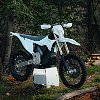
If one is being an entirely responsible motorcycle journalist, one has to ask oneself just who, exactly, requires a cartoonishly narrow, "Praying Mantis from Outer Space" hyperspace-capable dirt bike that somehow managed to become legal for operation on the street? Could you commute on it? Sure, and your schedule would probably appreciate the extra time yielded by getting to work shortly before you left home. Operation out in the backcountry would at least require some detailed planning for charging stops or a fixed base camp where electricity is known to be available. Folks lucky enough to live in rural areas will find the ability to backroad scratch on the way to and from unpaved roads or local trails is a pretty attractive combination.
Personally, I don't think that Stark Future spent a lot of mental bandwidth overthinking who it was for, exactly. One suspects their approach was more along the lines of "If we make this bike as stupid powerful, crazy light, and wicked fast as we are capable of, people will want one so irrationally that the rest will take care of itself." Some of those people have been hell-bent to talk to me when they saw me on the road riding the bike. Those folks are waaaay out there and are not scared to share it. Things might just be taking care of themselves.
Phil Burleson, the sales and finance manager at Frederick, Maryland's JT Motorsports, went a dozen extra miles to work with Stark to get the bike ready for me to ride. Stark delivers the bikes with a rear brake that is foot-activated to meet DOT requirements, but there is also a left-hand-activated rear brake provided with the bike, and given the clutchless moto didn't have anything else for my left hand to do, Phil had his service department install the hand-operated brake. That hand brake would turn out to be much easier to control precisely than the tiny pedal would be while wearing proper off-road boots. Stark had also recently started delivering a portable charger that could be carried in a backpack, and Phil swapped one of those out of his stock for the pit-stand version. If one intends to wander, having some insulation in one's pack against bad range calculation and the subsequent walk home is really part of good ride planning.
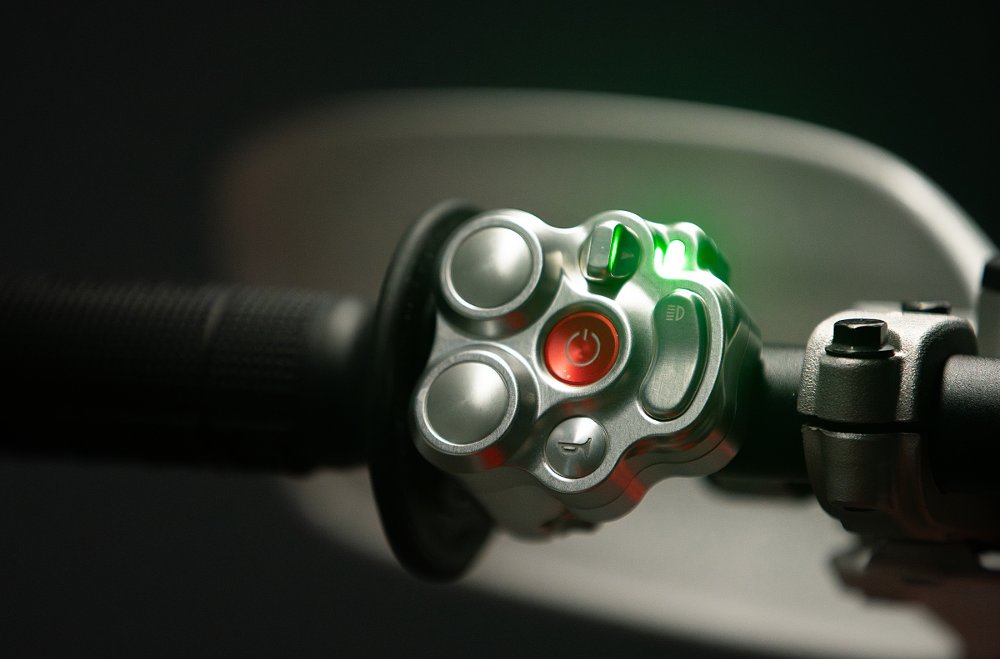
Phil also walked me through the operation of the controls, which, for the sake of conversation, appear closer to vintage Star Trek than vintage Kawasaki. There is a unitary control button cluster on the left bar. The buttons are large, round and illuminated, and communicate status information by changing colors. The bike also has forward and rear "walk modes," which Phil told me could be real bonehead-savers if I rode into something I couldn't ride out of, but are also helpful when loading or unloading the bike in a pickup truck or trailer.
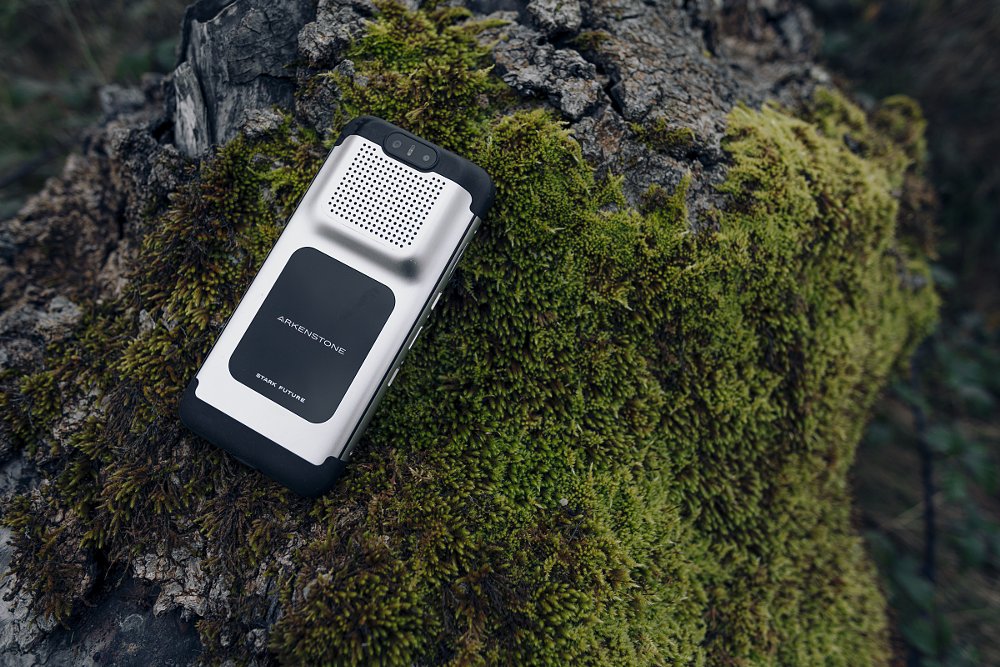
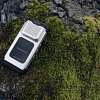
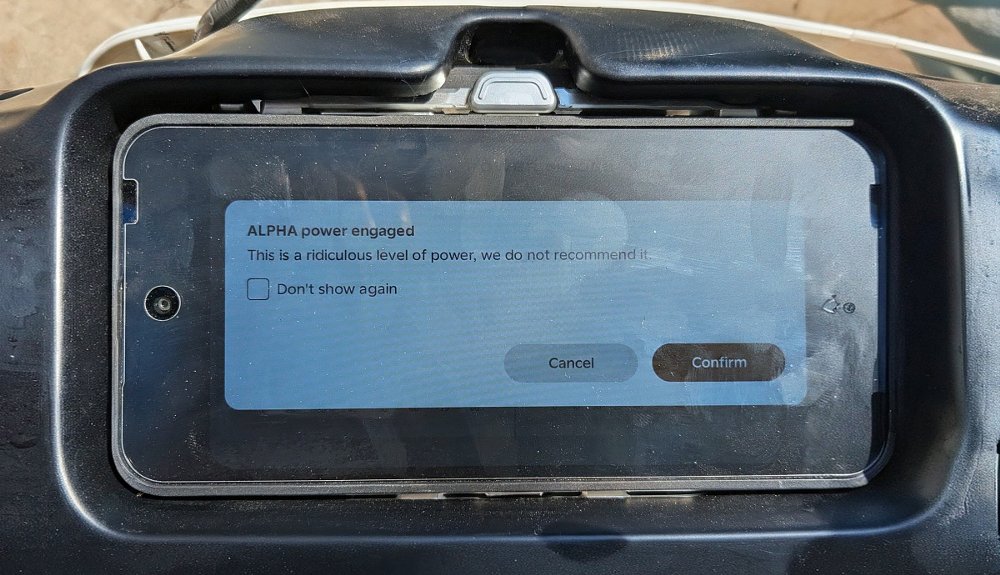
The main instrument panel is provided via an environmentally hardened Android phone, called the Arkenstone, which has a robust docking station — complete with charging and data connections — built into the VARG's cockpit. The Arkenstone runs a Stark application that allows the user to completely customize the performance parameters of five different saved profiles. The user can select the horsepower, regeneration percentage, and modify an actual power curve. The display shows the curve and the rider just uses a finger to drag it to the preferred performance level.
Want upper-end-biased peaky?
No problem.
Want the motor to come in fat right off the bottom?
Same.
Want both in two different profiles?
That's what it's for.
Folks who know me likely grow weary of me kvetching about new bikes that try to require that their pilot to load and use a phone app to be able to manage their motorcycle and how it works.
Kvetch. Kvetch. Kvetch.
We're way beyond that now, though.
Because the VARG is an app.
Using Android software lets Stark gather aggregate performance and error data, as well as manage over-the-air updates for any programmable components anywhere in the bike's power systems. You don't need an app on your phone to ride because anything user-configurable is easily configured directly on the bike's captive phone, which then directly translates user preferences and inputs into powertrain operation. It was far easier for Stark to adopt a widely supported hardware and operating system environment than to design and build their own.
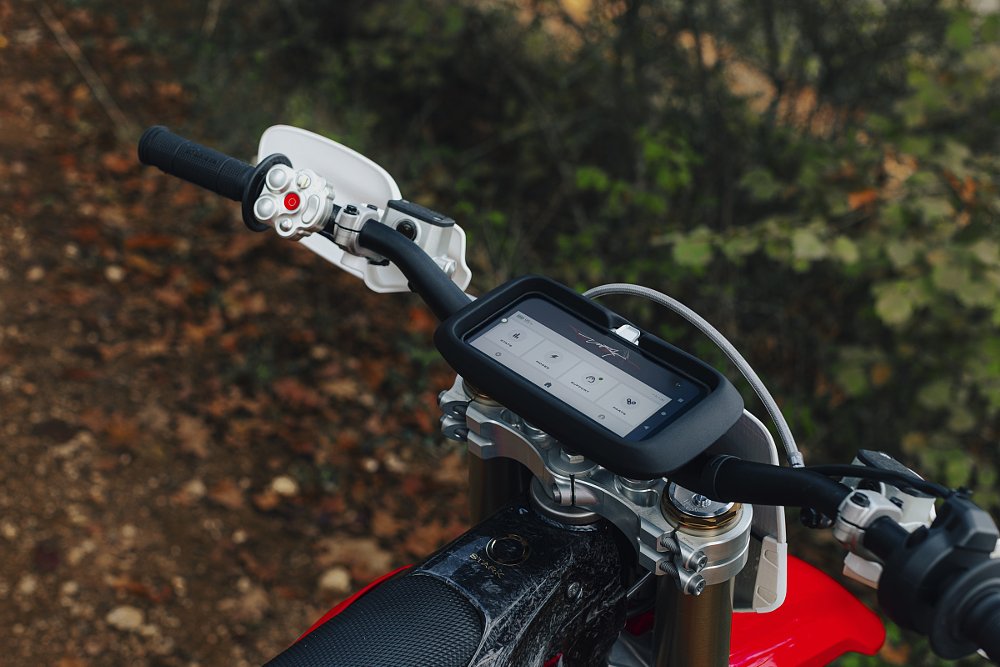
It's really kind of a genius move in the electric vehicle technology space. It also allows new features to be added to the motorcycle. During my time with the VARG, Stark began pushing out a traction-control function that used the hardware that was already there.
Think about a whole new set of functions, and make the bike do something it didn't do when you bought it. Try that with your '69 Sportster.
Enough tech talk; let's ride it
So, let's talk about my ride home from JT Motorsports.
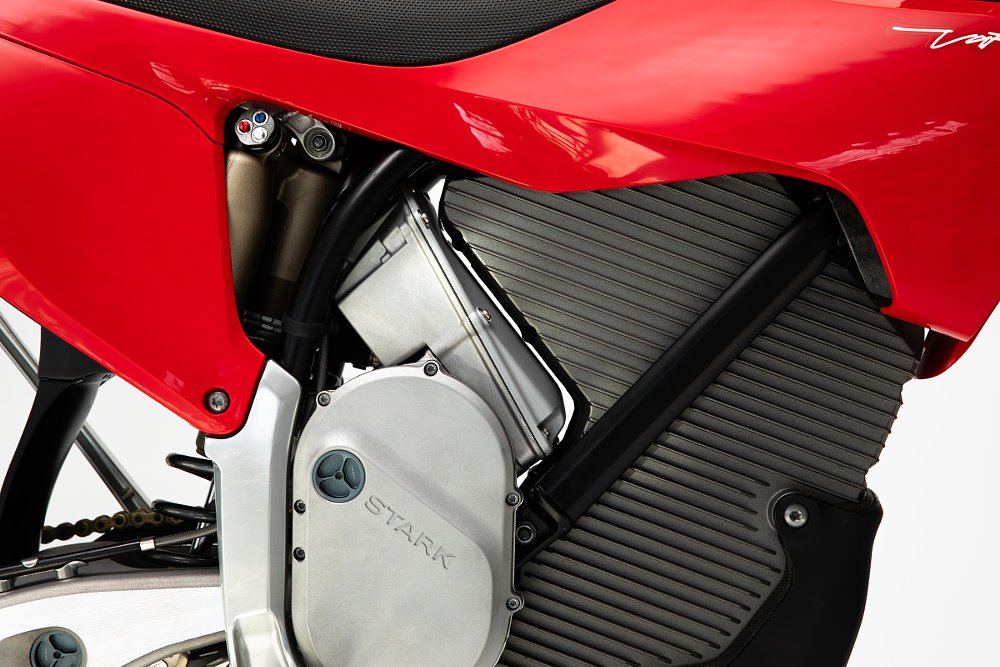
I spent a bit of time figuring out how to climb aboard. I was really happy that Stark had provided what I thought were two really functional tail grab handles, but they turned out to be exhaust ducts from the EX's trick undersaddle radiators for cooling the motor. I'm sure I provided at least a laugh or two to the folks who worked there, but five-foot, eight-inch me has minimal exposure to true dirt bikes and the VARG EX, with a saddle height of 39 inches, is waaaaaaaay up there. The good news is that with the rider aboard, the suspension sacks to about 38 inches, so that's an improvement.
Once in the saddle, I spent a few minutes swiping and clicking the Arkenstone to set up two power profiles that I would use near-term. Both used limited power — 38 and 45 horsepower — and enthusiastic regenerative braking settings. The idea was to acclimate to the EX's general handling and behavior before attempting to really uncork the thing.
One gentle twist of the throttle, though, set me completely at ease.
Power delivery was easily controlled at small throttle settings and power request changes were just as extremely precise. With its wide handlebar and very narrow body, combined with clutchless direct drive, I was instantly able to do tight circles and figure eights in the parking lot as if I'd been using this bike for motorcycle police rodeo practice for months. Shifting my weight while doing full-lock steering maneuvers gave me a sense of total machine control — a good sign for the type of riding I expected to do in the remainder of the brief test riding I'd planned.
With circus tricks for the dealership staff completed, it was time to find a winding way home.
Frederick County in Maryland, where I live, is the fastest-growing county in the state. Fortunately, there are some corners of the county that have so far escaped the developer's tools. Old Frederick had single-lane and unpaved roads that were built along stream beds out into farm country. These roads twist like drunken snakes and are a perfect place for bikes like the VARG. These roads run deep in the shade of old-growth woods with very few straight stretches and unpredictable corners that would never pass modern highway construction codes. Reels Mill Road is one of these old roads, and it begins about three-quarters of a mile south of JT Motorsports and cuts across the southern end of the county towards my home in Jefferson.
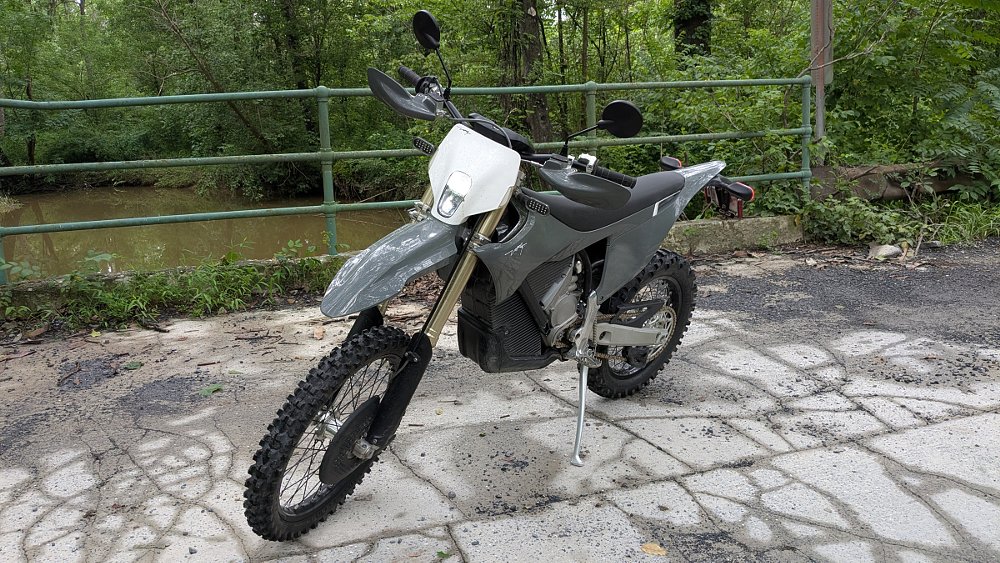
Running the VARG EX on a public road is an eye opener. Unlike some other street-legal electric motorcycles, the VARG's electric motor has some sonic personality. On the "throttle," the VARG has a definite scream to the engine sound, partially due to the use of thin panels of light metals in the cases, the focus on lightness, and a lack of concern about the sound output in a competition environment. There is also a great deal more driveline noise than most electrics — many of which are belt-driven — given that the 520 chain Stark specifies needed to be sized for the stout 80 peak horsepower.
On-road handling, even with competition-grade knobbies, is razor-sharp. The bike changes direction effortlessly and, combined with the instant response to throttle input, I found myself ripping down a narrow road after only a few minutes of acclimation. It was almost as if the machine itself all but disappeared underneath me. Acceleration, deceleration, and turning became nearly transparent, gestural. Think about it and it was done.
I left JT with a battery that was charged to 85% but was having such fun that I stretched my ride home to about 40 miles, arriving with just under 40% showing remaining. During the ride I swapped up into my 45-horsepower mode and demonstrated to myself that just over half the available power still made the VARG the quickest electric motorcycle I've ever ridden. For comparison, the Can Am Origin that I enjoyed riding made 47 horsepower pushing a 412-pound package. With the VARG set at 45 horsepower, and weighing 264 pounds, the power-to-weight ratio was nearly double, and it felt like it. With the user-configurable power curve, big throttle openings at higher road speeds were dramatic enough that both my shoulders hurt after the ride home.
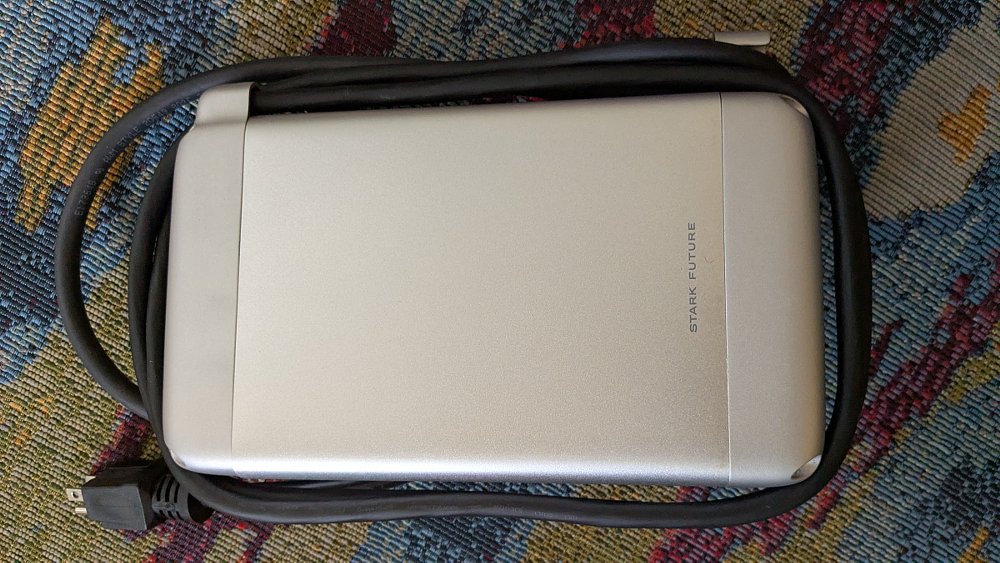
After getting home, I pulled the VARG EX around to where an electric socket could be directly accessed by the backpack charger and set the bike to charge. Once plugged in, it was clear that some of my "stealth charging" techniques I'd used in the past in park lands and public campgrounds were not going to work with the VARG. The Stark backpack charger has two high-speed cooling fans and sounds like a datacenter rack full of servers and network gear when it is running. Sound pressure levels are high and the high frequencies are annoying. One is not going to plug this bike in anywhere and have one's neighbors be unaware of what you're up to.
So the real job was to map out a route that would take me through the gnarliest territory within riding distance of my house, to see how this machine would perform in its natural habitat. And after having to deal with an unbearable day or two of delay, while local temperatures camped out in the 102-to-105-degree F range, I finally headed for the woods with a full battery.
During the time I was hiding from the heat, I did make some adjustments to several of the five available power modes. I changed my two default modes to 45 and 55 horsepower while retaining four-stroke-engine-like levels of regenerative braking. I set mode five to full available power. When I did this, I got a message advising me that the selected 80 horsepower was "ridiculous" and "not recommended." As a guy who was already a tad anxious about it, that may have been informative, but didn't do anything for the rider's emotional state.
On the only really long ride the short evaluation period was going to allow, I started out by heading for the unpaved road and stream crossing that's about a mile and half from the end of my driveway. At the point where the gravel drops into the creek, I was standing on the pegs and working just above walking speed. My vantage point from way up there allowed me to see the rocks under the water and I literally rode across and slalomed between the larger stones during my crossing. The level of control was so ridiculous that I turned around once across and came back, deliberately not hitting some of the larger rocks at a 90-degree angle, a situation that would normally have a rider taking an unplanned swim. The combination of the Metzeler 6 Days Extreme tires' level of grip and the suspension travel had the VARG laughing at that challenge, too. I didn't know it yet, but that would prove to be the theme for the day.
After four gratuitous (but fun!) stream crossings, a newly more confident tester headed out Siegler Road, which is a wide, well graded gravel road. I slid out of a few corners and headed for my Northern Virginia Unpaved Test Loop. Coming down U.S. Route 15 towards the river, I continued to be astounded by the level of acceleration available from my selected mode's 45 horsepower. Power-to-weight is definitely a thing.
After crossing the river — above water, Bud, on a bridge! — I made the turn onto Furnace Mountain Road. Furnace Mountain Road is a gut checker of a trail for something with a street sign at the end. Right from the start the road has a very steep grade with a loose, rutted surface and upon reaching the top of the ridgeline there's a series of narrow switchbacks with limited to no visibility and a sharp drop off into a deep ravine off the right ride of the trail. Blasting up the initial grade was trivial with the VARG EX's power. Cornering behavior up on Furnace Mountain felt a lot like riding on suction cups. Unlike a lot of motorcycles, where riding standing up is necessary to get the required amount of weight over the front tire, that isn't necessary on the VARG. The battery pack is positioned toward the front, wrapping around the top of the motor and as close to the steering head as possible, so heavy parts on the bike weight the front wheel. Stand if you want to, or if you feel you should on rougher terrain, but that front wheel is going to bite on soft surfaces so long as your throttle position keeps it on the ground.
Furnace Mountain also has a few hairy descents. Keep the VARG rolling downhill and it will swallow ruts and steer though them, if desired. Ruts that will take a lesser motorcycle off line don't concern the VARG EX rider. There are also more than any trail's share of tight, off-camber switchbacks, and I never managed to generate enough cornering force to scrub the front wheel or to have the bike do anything but go exactly where I pointed it.
Furnace Mountain Road ends in the tiny village of Taylorstown, Virginia. About 120 yards takes a rider from one side of Taylorstown to the other, and Downey Mill Road takes you out of the village. Downey Mill follows Catoctin Creek though the woods, and the trail's proximity to the creek means the surface gets flooded with startling regularity, leaving the road filled with chuckholes, deep puddles, and soft, muddy areas that never manage to fully dry out. Normally, I pick my lines carefully through the creekside section, but on the VARG EX I was aiming for bad lines to see if there was anything Mikie wouldn't eat. I never did find anything. The combination of light weight, long-travel suspension, and great traction make the VARG EX easy to pilot in even the filthiest of conditions.
Another section of Downey Mill strings together steep grades, spooky descents, and rutted, off-camber switchbacks that have challenged lesser machines I've taken on this loop but with the VARG EX I just kept on the throttle open and kept my cowboy whoops warmed up and at the ready.
Another part of my test loop is Dutchman's Creek Road, which extends deeper and deeper into the woods and ends at a private property that sits on the banks of the Potomac River. To get to the river end really requires either a four-wheel-drive vehicle or a pretty capable off-road motorcycle. There's a low-water stream crossing and multiple hairy grades and descents, all sitting on loose, heavily rutted, and off-camber surfaces. It's the final bit of local public "road" to which I take off-road-capable motorcycles for testing. I've ridden here on larger machines that brought my heart into my mouth on some of the steeper sections, but the VARG EX just laughed at all of it. There were no anxiety-producing moments of any kind.
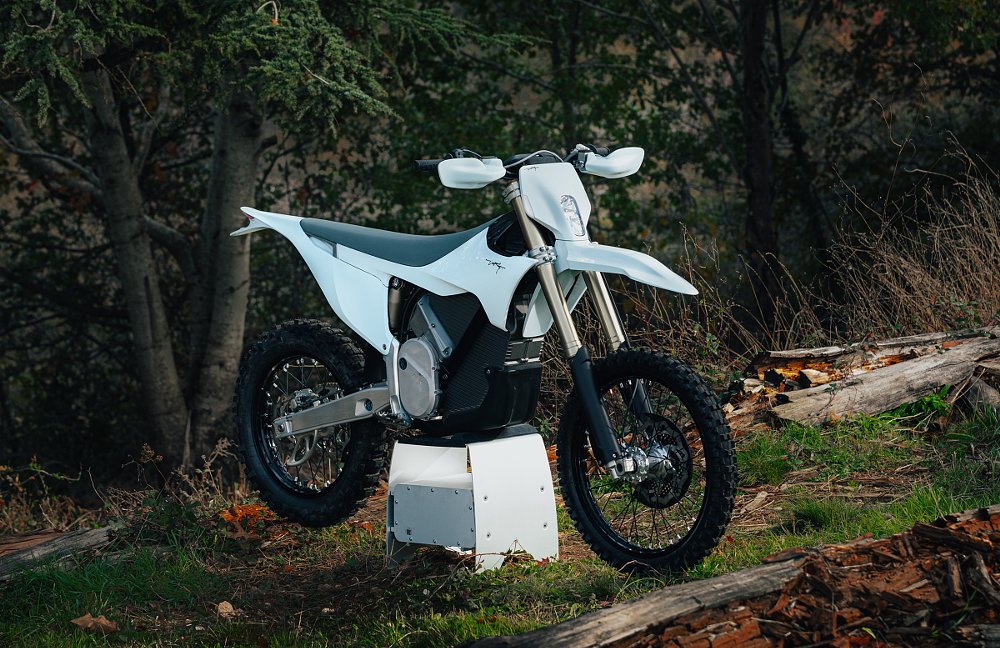
I ended up extending my ride onto some other Maryland roads out in farm country, but ran out of roads well before I ran out of battery. Running with conservative levels of horsepower configured, 70 to 100 miles shouldn't be out of the question. Stark defines their range estimates in terms of riding time, rather than mileage, with the assumption that a Pro Racer will be able to run at higher horsepower and higher levels of output than most mere mortals, such as yours truly. Their estimate of over four hours of riding time for a newb seems spot on.
My brief time with the bike ended far too soon, although not before I blasted it through every bit of unpaved surface within 50 miles of my home in the days after that test ride. The roads around Sugarloaf Mountain provided another fun day, especially after a really bad afternoon of thunderstorms had washed out all of the roads and dropped plenty of trees and tree bits onto the trails.
As I rolled back over to JT Motorsports to return the bike, I realized I had never selected my 80-horsepower Mode 5 profile. I briefly considered engaging full power on the streets of the industrial park in front of the dealership, but decided discretion was the better part of valor.
Don't judge me. I survived my rides on the Stark VARG EX with no crashes, wipe-outs, plaster casts, or medical consultations.
If you want hairy-chested confidence, I'm sure Zack will be along soon with his take on the Supermoto version, with its stickier tires and bigger, dual front brakes, no doubt exploring the ridiculous and unrecommended.
Best of luck, guy!
| 2026 Stark VARG EX | |
|---|---|
| Price (MSRP) |
Standard: $12,900 Alpha: $13,900 |
| Drivetrain | 360V electric PMAC |
| Claimed horsepower |
Standard: 60 Alpha: 80 |
| Frame | Tubular steel |
| Claimed range | 1.3 to 6.0 hours riding time |
| Claimed battery capacity | 7.2 kWh |
| Claimed charge time |
3.5 hours @ Level 1 2.0 hours at Level 2 |
| Front suspension | KYB 48 mm cartridge fork, adjustable for compression and rebound damping; 11.8 inches of travel |
| Rear suspension | KYB shock, adjustable for preload, compression and rebound damping; 11.9 inches of travel |
| Front brake | Brembo two-piston caliper, 260 mm disc |
| Rear brake | Brembo single-piston caliper, 220 mm disc |
| Rake | 26.1 degrees |
| Wheelbase | 58.6 inches (148.8 centimeters) |
| Seat height | 39 inches (99 centimeters) |
| Tires | Metzeler 6 Days Extreme, 90/90-21 front, 140/80-18 rear |
| Claimed weight | 265 pounds (120 kilograms) |
| Available | Q1 2027 |
| Warranty | 24 months |
| More info | starkfuture.com |