 Riders Preferred Membership
 Log In
 Shop by Vehicle
 Track Order
 Contact Us
Statistically, 0.2% of you saw the title of this article and got excited. For the other 99.8% of you who were kind enough to trust that the article wouldn't be rubbish: "QRP" means "reduced power," "QSO" is a two-way communication of any type, and "KLR," as you already know, means "unkillable moto-cockroach." The unfamiliar shorthand terms, dubbed Q codes, are used by radio amateurs to save time and keystrokes.
As you've likely surmised, I am a ham. That's true in more ways than one, I suppose.
The genesis of a motorcycle trip
A few months ago, Nate, my usual long-trip riding buddy, asked me if I wanted to fly to Idaho and ride into Montana and Wyoming with his colleague. Does the Pope shit in the woods? I'd been trying to get him to do a fly-and-ride for years. I immediately said "Yes" and invited a buddy of my own, making us a foursome.
As our group chat progressed, I mentioned I wanted to hit the Beartooth Pass, because I had a plan brewing. The road through the mountains, accessible only for a few months a year when snow isn't blocking the way, sits at a little over 10,000 feet of elevation; it's not any type of an altitude record-holder. However, it's significantly higher than my home radio station in the Appalachian Mountains at around 1,000 feet.
I saw this trip as a unique opportunity to combine two of my hobbies. I explained my plan to the other guys on the ride and they were willing to modify the trip to suit my cockamamie scheme.
Necessary nerd stuff
There is motorcycle stuff ahead, I promise, but there are two radio things you need know to make sense of this story. (If you’re a ham, I'll probably set you off because I'm going to paint with a broad brush in the interest of keeping it simple and holding the interest of the general audience.)
We hams already know the first question we get from non-hams: "How far can you talk on one of those things?" Like someone asking you "How fast is a motorcycle?" the answer is, "It depends on a ton of variables." Things like frequency, power, antenna design, environmental factors, time of day for both transmitting and receiving stations, and even solar weather conditions play an enormous part in the answer to that question.
One thing almost all hams will agree on is that no one factor matters more than the antenna. You can have a badass radio, or tons of power pumping out of an amp, but if all other factors are equal, a well-designed antenna placed as high as possible is almost always a trump card. You probably see where this is going.
The other thing you need to know is the difference between simplex and duplex communication. Simplex communication is what you did with your tin-can telephone as a kid: Station A talks to Station B and vice versa on one frequency. Duplex communication is talking on one frequency and listening on another. For the purpose of this piece, you can think of this being necessary because a repeater is in use. A repeater operates really similarly to a cell phone tower: You use a little radio (like your iPhone) to talk up to a much bigger transmitter (the tower) that repeats your message to another tower (or series of them) and then to your call recipient's phone.
Your phone service provider obviously uses the internet and all sorts of other trickery to efficiently route calls, but in radio, most hams will consider simplex contacts the "purest" form of radio. Repeaters or modes using the internet are usually sort of second place. No matter the band, hams want to be our own telecoms. We all use and love repeaters, but no matter if it's HF, VHF, or UHF, bragging rights and experiment results are almost always expressed in terms of simplex contact distance.
HF (High Frequency) is the standard for speaking really far (and it's usually what you see on TV when a ham is depicted) but we like to push the limits on all frequencies in the name of experimentation. On UHF and VHF, my previous simplex contact records were with my buddy Angelo at 5W of power "making the trip" 13.06 miles.
TL;DR: High antennas work best, and my goal in going to Beartooth Pass (in addition to taking a cool motorcycle ride) was to beat my personal UHF comms distance record of 13 miles.
The trip is on
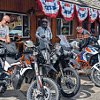
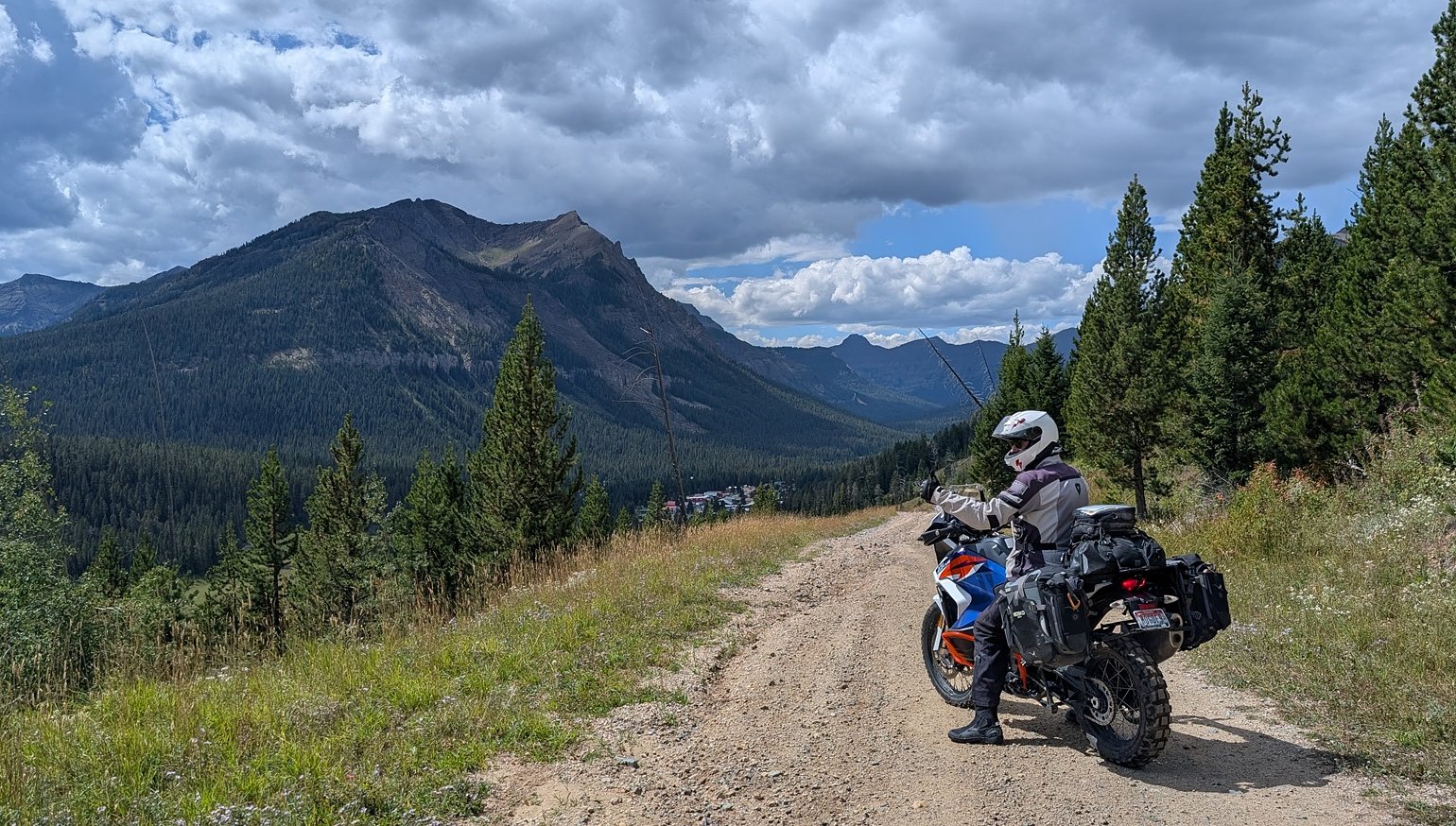
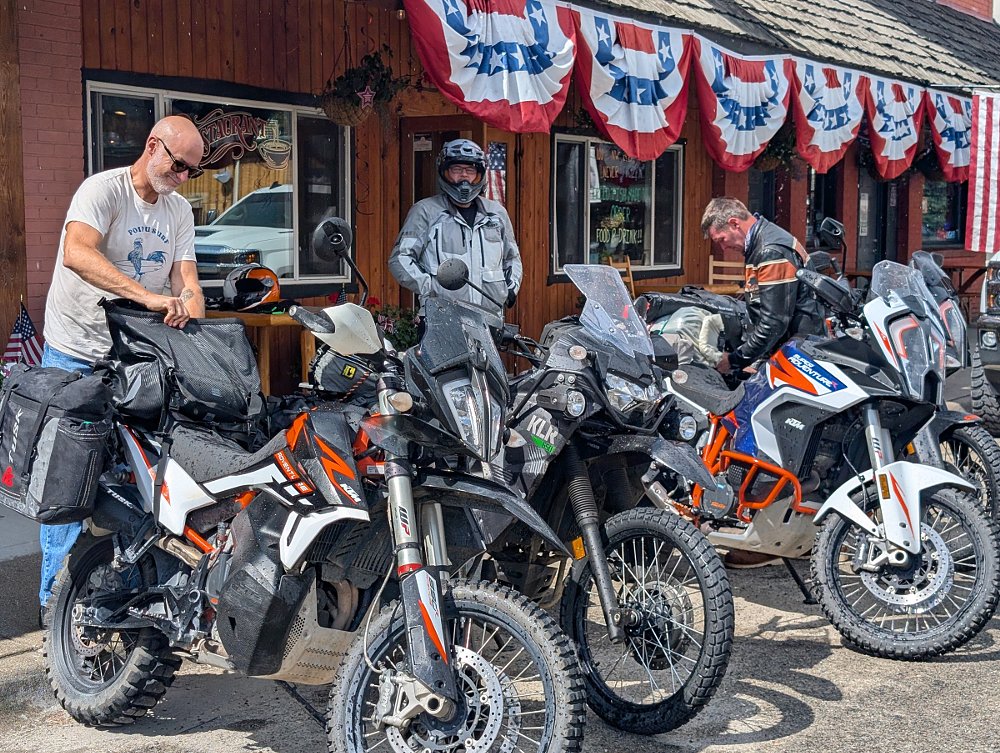
OK, now we're on to bike stuff. My compadres all chose KTM 1290 Adventures or Super Adventures we got from Idaho Backcountry Adventures. Super company, and that ain't a paid advert. I like to do things the hard way, so I selected a 2023 Kawasaki KLR650 as my mount. Yes, I was spotting the other boys 120 horsepower. But I'm a strong rider, and the advantages off-road seemed obvious.
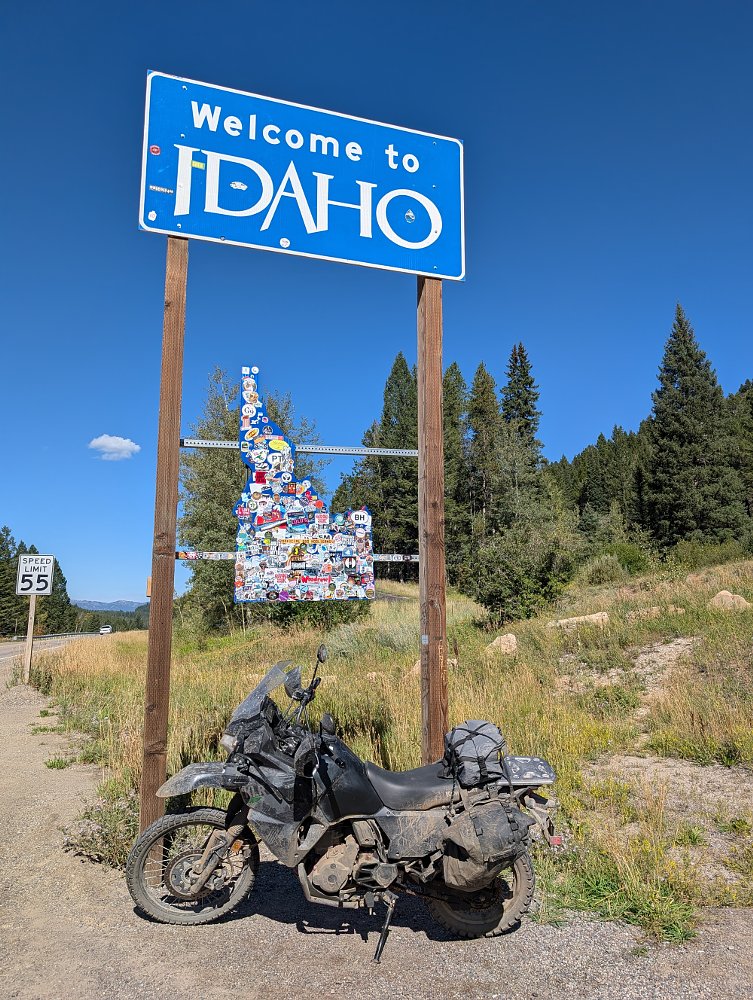
In case I forget to sum up the gutsy thumper later, it was the perfect companion. When I considered what I asked of it relative to what Kawasaki asks for it, the value it packs is astonishing.
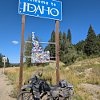
We made our way north through Idaho, a beautiful state. Occasionally when we'd stop, I'd throw calls out on the national calling channels (146.52 on two meter, and 446.000 on 70 centimeter.) I wasn't getting responses. I could see in my riding companions' eyes that they were doubting my ability to make this article a reality.
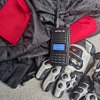
My failure wasn't really abnormal. Due to the packing constraints on the motorcycle, I had to make do with a small, modestly powered portable radio, but I did do my level best to give myself a fighting shot. I packed two types of antennas, made some home-brewed helpers (tiger tails), and I've hot-rodded my radio a little bit. I use UV88 clones almost exclusively for GMRS, UHF, and VHF operations (with some tweaks to make them the best they can be). With my better battery and antenna, the whole rig still costs under $49, so I have a few. They're cheap and small enough to take along to many places.
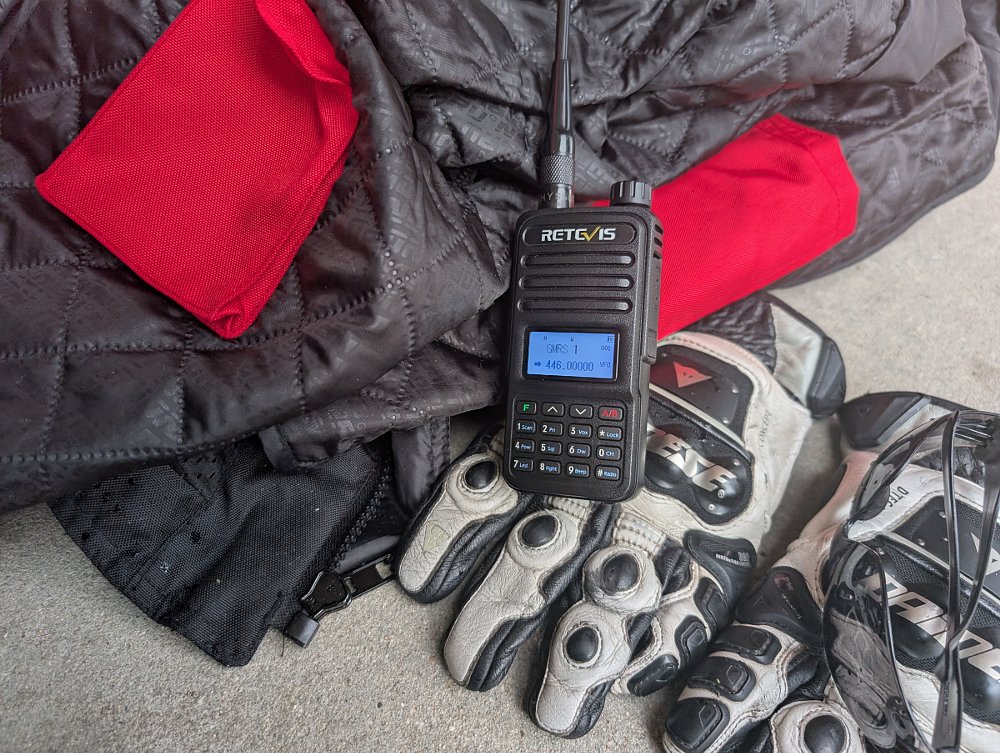
The doubt in their faces did make me a little nervous, but I also knew where my little, limited rig would have a fighting chance, and it wasn't in one-horse towns down on the ground. My time to shine was coming on higher ground in a few days.
Before we set out, I made acquaintance with Charlie, a Montana ham, who had begun feeding me local information before I left home. We hatched a plan to coordinate to see if we couldn't have a crazy-far VHF or UHF QSO. (Remember that term from before?) My call sign is in District 3 and he's in 7; I contacted him thinking having a short-range QSO in his log with a D3 would be interesting, and he was game. Charlie is about 100 miles from Beartooth Pass. Both of us were eager to have a QSL card (a postal card mailed to confirm a radio contact) from the other in our collections. I was actually thinking of his card as a sort of postcard for myself; an unforgettable memento of a trip not every motorcyclist is lucky enough to take.
I wanted that card bad.
As a little aside, hams are like motorcyclists: If you ask one for help, they're crazy-friendly. Charlie had switched to providing all sorts of local info as the trip was underway: fauna to avoid, good routes, places to stay, fuel stops, the works. He used to ride a motorcycle, so he understood what we were doing rather well, and his insights were invaluable.
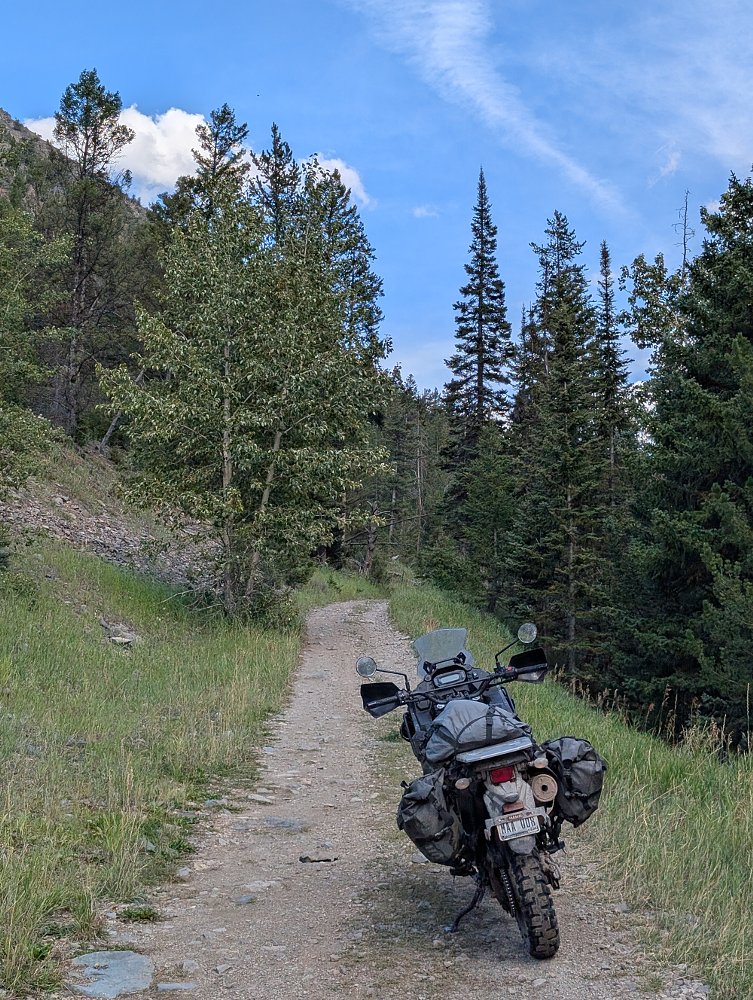
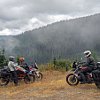
As we progressed north, closer to his territory, the terrain became more rugged and we found ourselves off-road more and more frequently. The trip was becoming more exciting with each passing day, the scenery moved from "awe-inspiring" to "that could probably make someone convert to religion." The KLR kept buzzing right along, doing everything I was asking of it. On the road, it began to feel out-of-sorts at 80 mph if calm, and closer to 70 mph if the winds kicked up.
Off the road, it was a pretty nimble companion. I had packed tire tools, but I could hear Spurg in my mind chastising me for leaving my tires at street pressure. I really didn't want to deal with a tire coming off the bead, so I picked my lines carefully. It was almost kismet, really: The suspension and brakes would quickly get overwhelmed. The KLR was a billy goat in first gear (albeit a pudgy and slow one). I could get up to a race pace in the top of second, but the suspension didn't like that. And the brakes had their own unique problem that was especially noticeable on descents: The KLR's ABS can't be turned off.
If I owned one of those bikes, I would personally run a switch into the rear sensor and mount it on the dash so I could toggle it on the fly. Some of you may consider the need to perform that kind of work a flaw. I think I actually like that better than the alternatives, since I hate having non-sticky ABS settings I have to manage from a menu.
After days of beauty — Glacier National Park, the Going-to-the-Sun Road, the Salmon River, Flathead National Forest — we approached Red Lodge, Montana. Charlie gave me the information for the local repeater in the town, so I began programming the radio. One needs to know the frequency, the tone (subaudible noises that "tell" the repeater you're trying to make it do work), and the offset. VHF, which is what their repeater was on, typically uses a 600 kHz offset, so you transmit on a frequency 600 kHz away from the one you listen on.
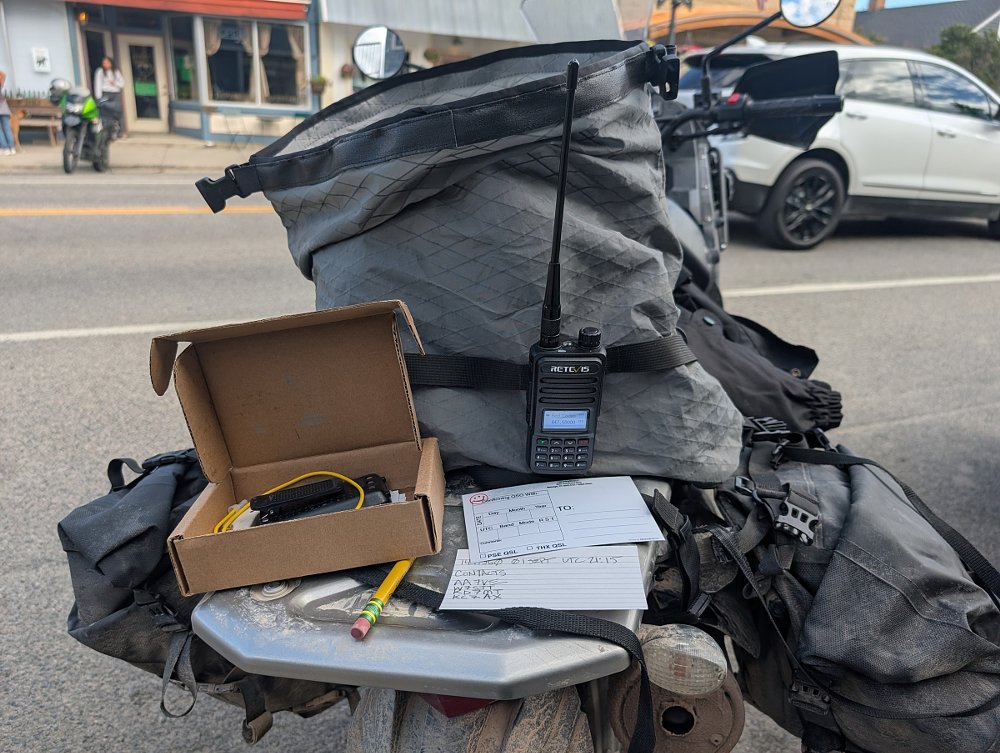
The other boys stopped to eat lunch, and I told them to go ahead without me, because this repeater was my only real shot at making some contacts. I set up shop on the KLR's tail section in what must be one of the most compact stations I've ever operated.
I tuned in and could hear hams talking, but they didn't seem to hear me. I frantically began troubleshooting, and after some confusion I realized I had programmed the offset incorrectly. It was a positive offset, and I was using negative like a dope. I switched it, keyed up, and threw my call out there, and W7SJT "came back" to me. I had a QSO. At least something was in the bag for this story.
Being that this is a small-town area and I had a weirdo District 3 call, hams started keying up. AA7VE chimed in, then finally, a familiar call cut through. I could hear Charlie's voice for the first time. KC7AX, Gary, the owner of the two-meter repeater, also took time out of his day to say hello. I dutifully kept notes for my station log. It was like walking into a party or a bar — or a motorcycle shop — when you feel as though you've made instant friends. We talked a bit about what Charlie and I were planning, this overly optimistic 100-mile QSO, and then hung it up.
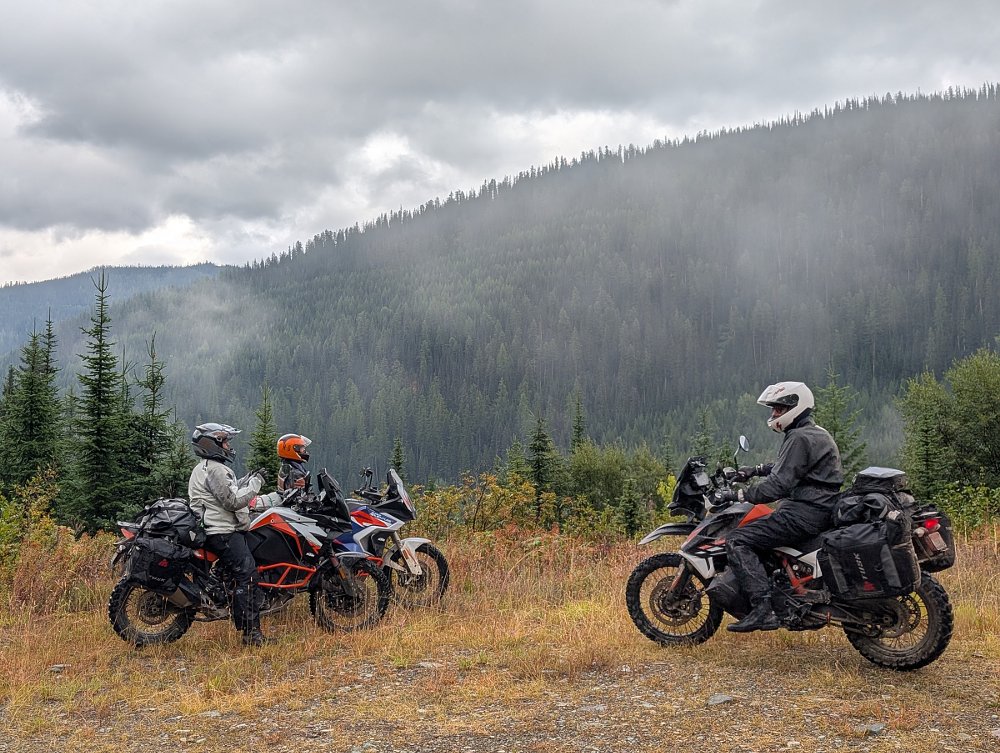
The fellas got back from lunch but they missed the whole show. We pressed on. Knowing we were to camp between Red Lodge and Cooke City, I loaded a crummy gas station dinner into my saddlebags. The towns are 65 miles apart, and the mountains cut off cell service and fuel access. More importantly there is a weather aspect. It changes fast and things can get dicey. Oh, and it's grizzly territory. Sounds like a great spot to stop and play radio, huh?
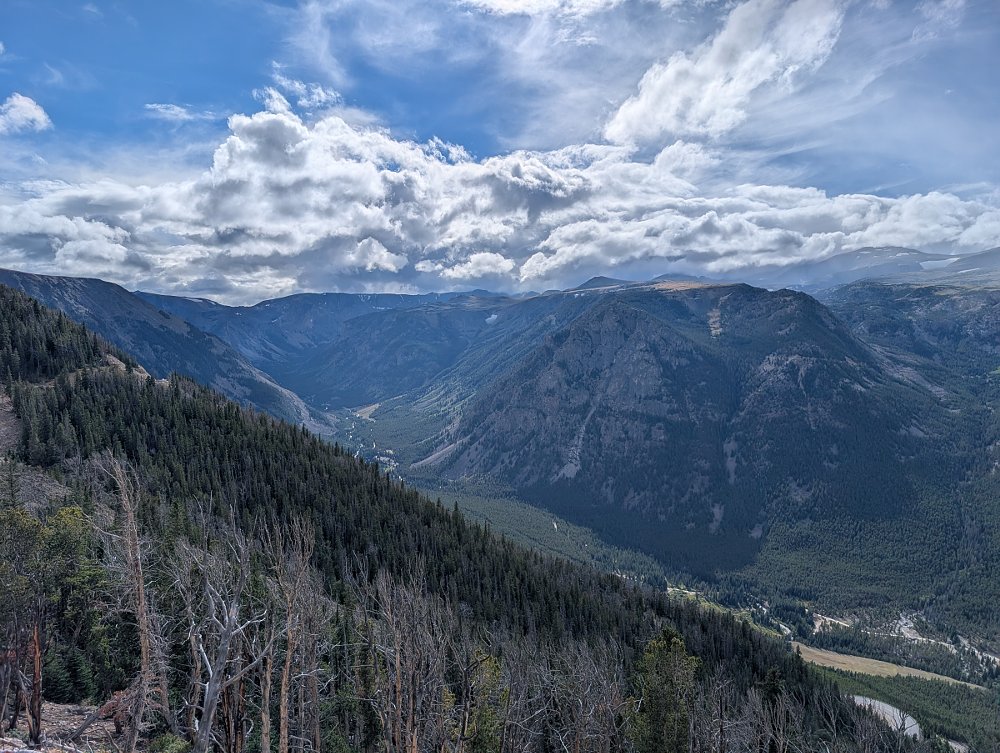
We ascended. The KLR was fueling fine, but the thin air noticeably degraded its performance. However, we made headway and I was still easily able to traverse the hairpins and the switchbacks at speeds that were inadvisable.
Failure and redemption
Eventually, I found the scenic lookout. Though not positioned at the very tippy-top of the pass, I selected it because there was a good walkout that got me away from having a mountain immediately at my back, permitting my antenna to throw signal in more directions.
I fired up the national 70 centimeter calling frequency (446.000, remember?) and began calling for Charlie. One mistake I made was forgetting I would have no phone service, so I never set a calling window with him. But he knew I was going up the pass, so all I could do was hope.
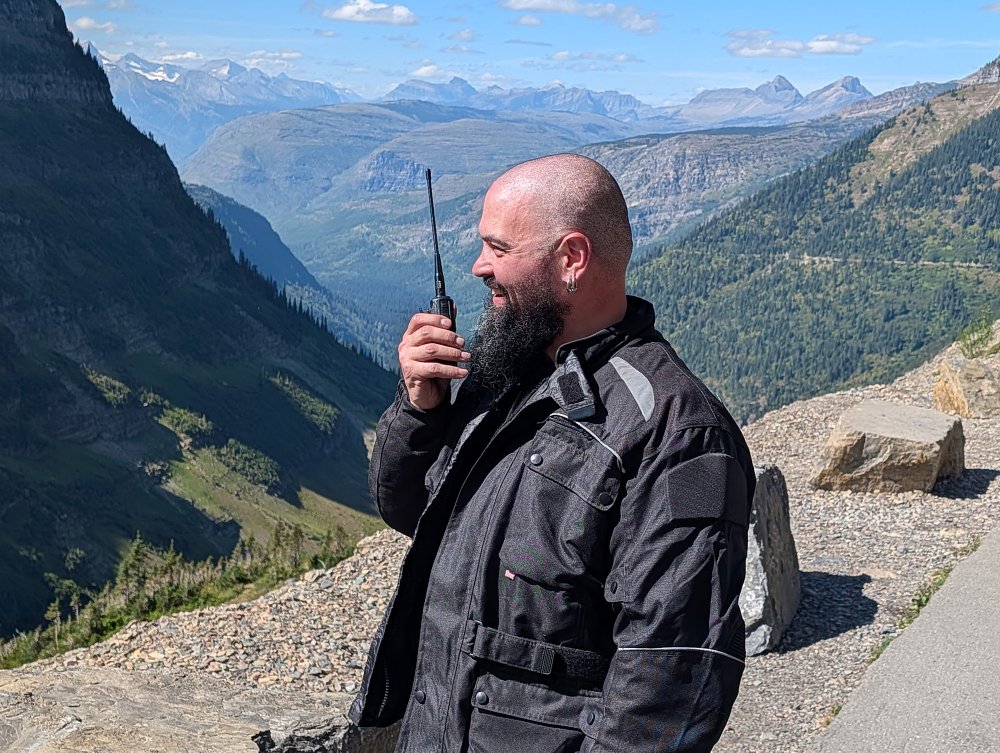
"Kilo Charlie Three Zulu Uniform Tango calling Kilo Delta Seven Mike Tango." Over and over. Nothing. It wasn't working. Charlie didn't have his radio on, or maybe his antenna couldn't pick me up. Or maybe my radio didn't have the guts. It was looking like a bust. My dreams of a 100-mile simplex QSO collapsed.
"ZUT, I know you're calling Charlie, and maybe he can't hear you, but I'm picking you up. Make sure you're holding that antenna correctly. Swing it around so my signal sounds strongest."
I had done that, but oddly, moving just 16 inches backwards somehow vastly increased my readability on receive. The voice I was hearing was Gary, KC7AX, the repeater owner I had spoken to. As we conversed, he relayed information from Charlie, who could hear him but not me. We spoke for a while. Gary told me stories about his daughter-in-law's uncle, who evidently was a drinking buddy of Ernest Hemingway when he stayed at the L Bar T Ranch in 1930. (Hemingway set a short story in that very area that was published in 1933, in fact.) Next, Gary gave me his station QTH (location). He gave me a rough distance and I made a mental note to calculate it later. He relayed well wishes from Charlie, and we concluded the QSO.
Finally, the thing that happens whenever I bring a non-ham into my shack happened: My compatriots began nodding and asking questions about the equipment and licensing. It's the same thing that happens with motorcycles.
I packed up my "station" and continued down the road. We made camp at about 6,500 feet of elevation. I ate my skimpy dinner and settled into my sleeping bag. The KLR didn't afford room for frivolities like a tent. As I lay looking at the stars peeking between the foreign-to-me Ponderosa pine branches, I was elated. This very article was now a viable entity, but more importantly, I had achieved my offbeat goal of a DX (long distance) ham contact using a motorcycle as an integral tool to do it.
Epilogue
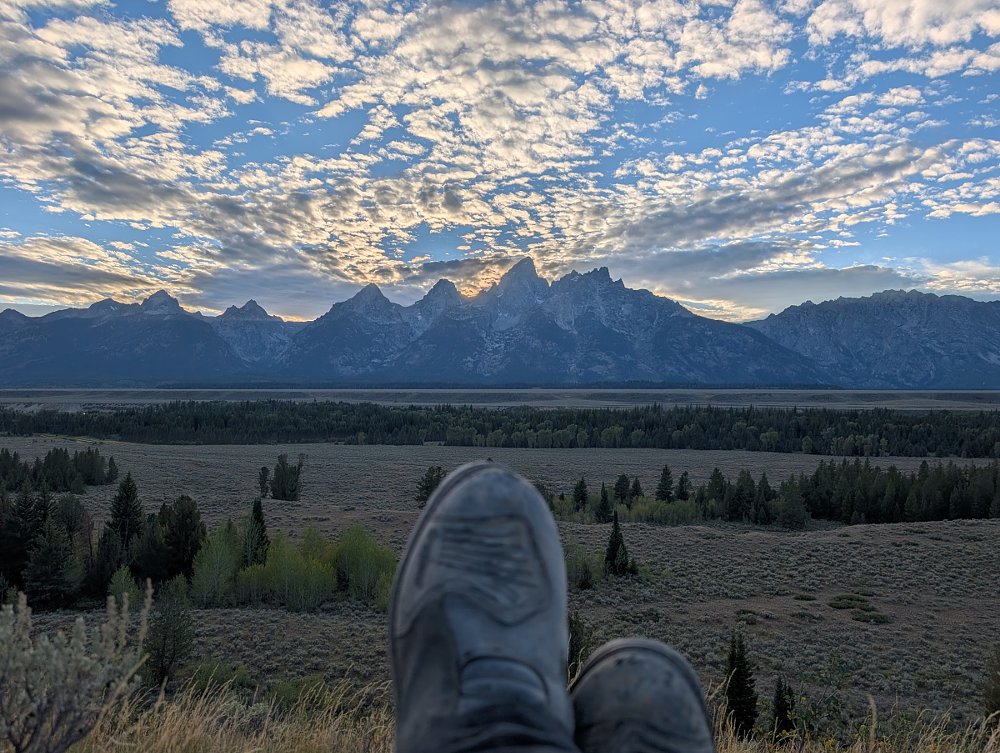
We continued on our journey. I took in vast swaths of Yellowstone and the Grand Tetons. The KLR was flawless for 1,783 miles over six days and six nights. After returning home, I filled out my permanent log and a ton of QSL cards for my new friends, and checked the map.
My new simplex UHF record stands at 73 miles, besting my previous attempt by a factor of five.
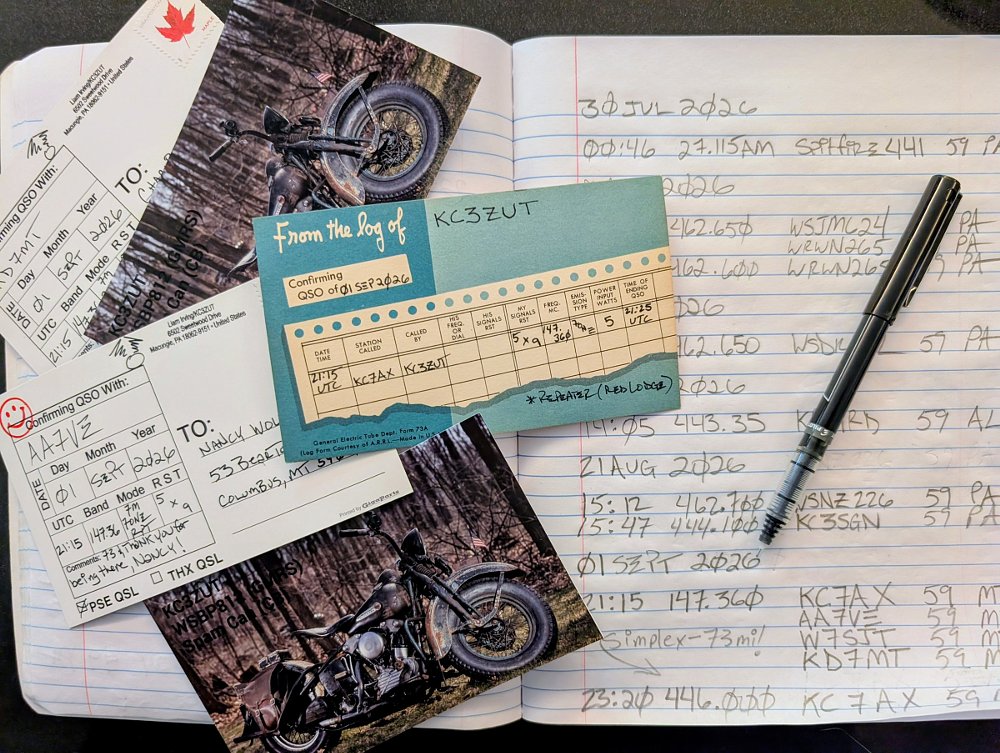
I set that record on 5W of power. (As a frame of reference, I'm licensed to use up to 1,500W.) That's a claim that can be made only by those hams who have put in the work to either build incredible stations or ascended to incredible elevations; it's outside the realm of most typical setups without some help from a repeater.
The motorcycle is an excellent tool to add to a ham's arsenal. It's more nimble than a car yet offers more onboard power than a horse. That means a fairly large antenna and amplifier could be carried and powered by the bike. I'd like to try a 10m setup using 100W next time. I'm glad I attempted this, and you should try it, too, if you want to get licensed. In fact, SOTA (Summits On The Air) exists solely for this purpose.
Spurg always says, "Put the phone down, get off the couch, and ride." I suspect he'll be OK with me temporarily adapting that to "Get off the couch, pick up a radio, and ride."