 Riders Preferred Membership
 Log In
 Shop by Vehicle
 Track Order
 Contact Us
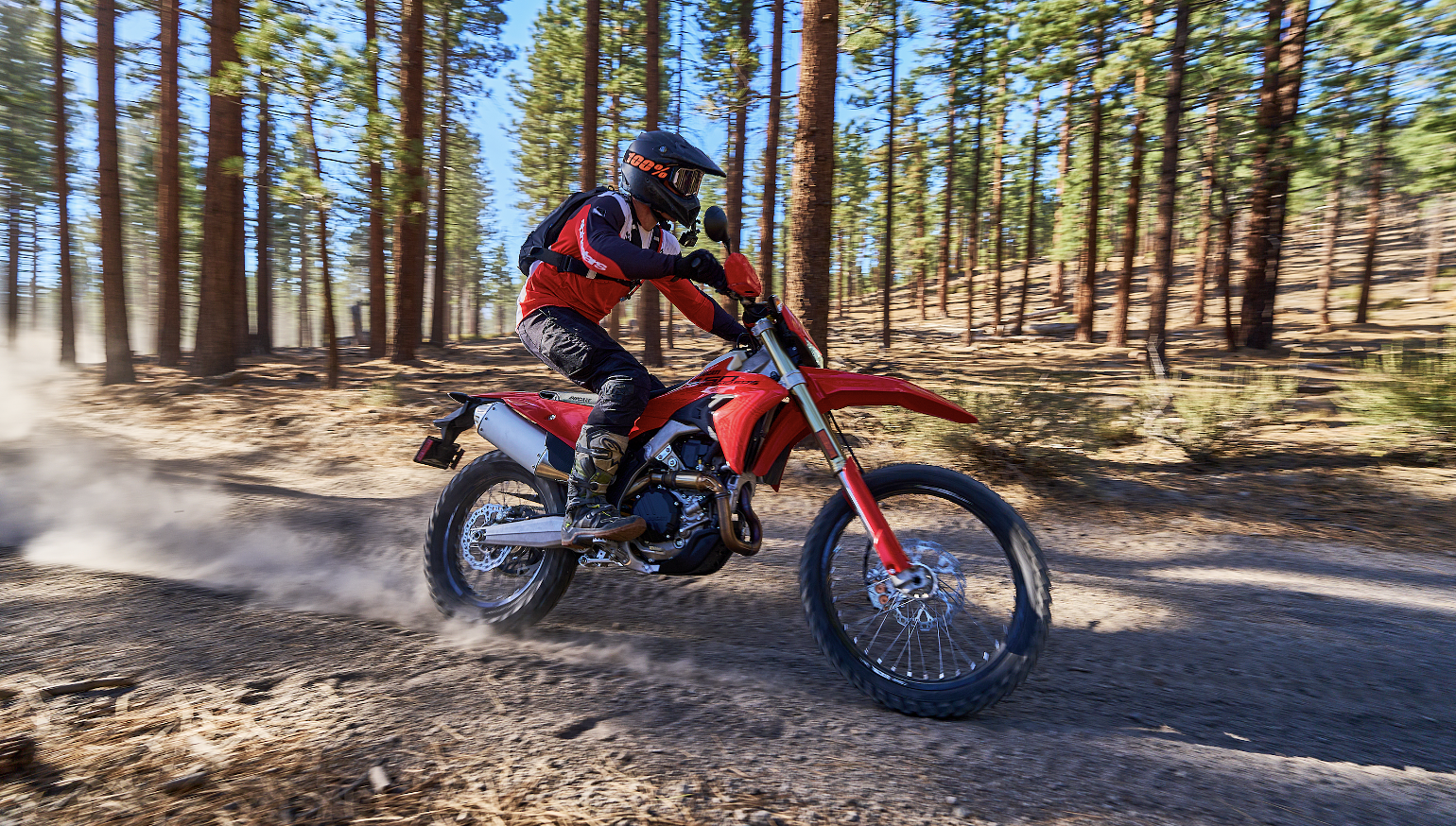
Ducati’s last offering in the street-legal enduro segment was the 450 R/T, sold from 1971 to 1974. Ducati North America CEO Jason Chinnock restored and rides a first-year R/T, in part because, like many motorcyclists and Ducatisti, he’s enjoyed off-road riding all his life. He also acknowledges that “a lot of our customers have another brand’s dual-sport in the garage,” so this is a natural place for Ducati to snag some conquest sales.
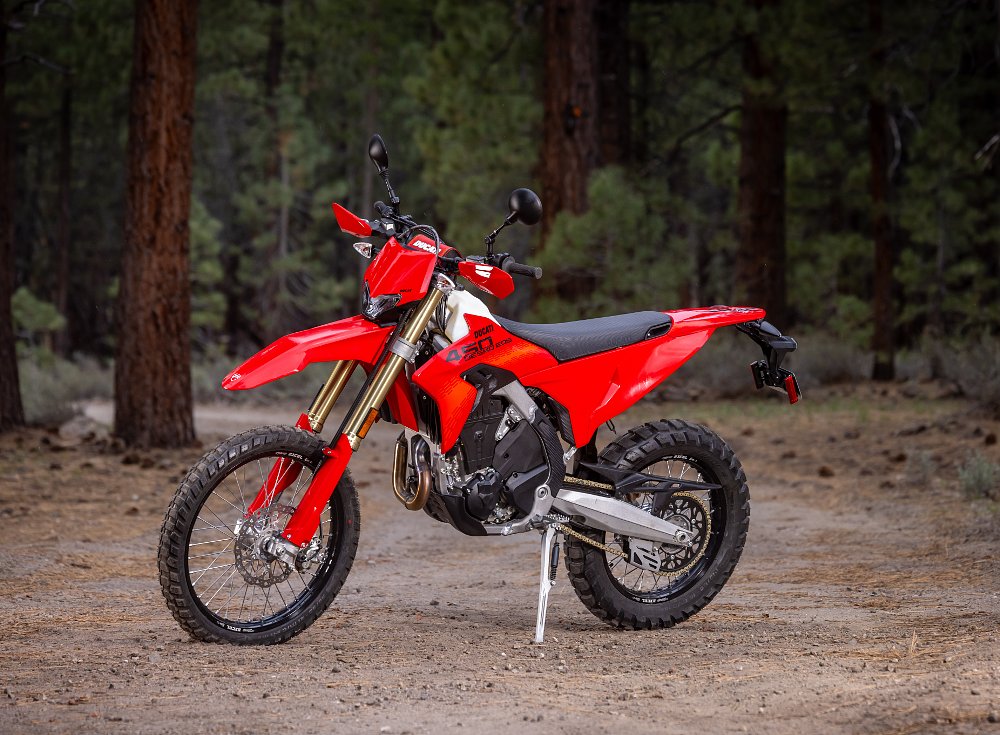
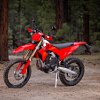
EDS stands for enduro street, and as is tradition for high-performance dual-sports, the Desmo450 EDS is based on a competition-only model, in this case the Desmo450 MX that was introduced in mid-2025. Going from a race bike that’s meant to be ridden 30 minutes at a time to an emissions-compliant motorcycle that can be enjoyed all day across a variety of surfaces required a slew of changes. We’ll start with the most enticing area: the 450 cc engine.
In an effort to enhance low-end grunt, Ducati lengthened the exhaust header and reduced the throttle body diameter by two millimeters. These changes work in concert to improve cylinder filling at low- and mid-range rpm. To tame throttle response, the compression ratio was lowered from 13.5:1 to 12.9:1 and 29 percent more mass was added to the crank. Bologna also slid milder cams between the desmodromic system’s opening and closing rocker arms, lightened the clutch spring (it’s a single Belleville-type diaphragm), and revised the existing five ratios in the transmission plus threw in an overdrive sixth for easier high-speed riding.
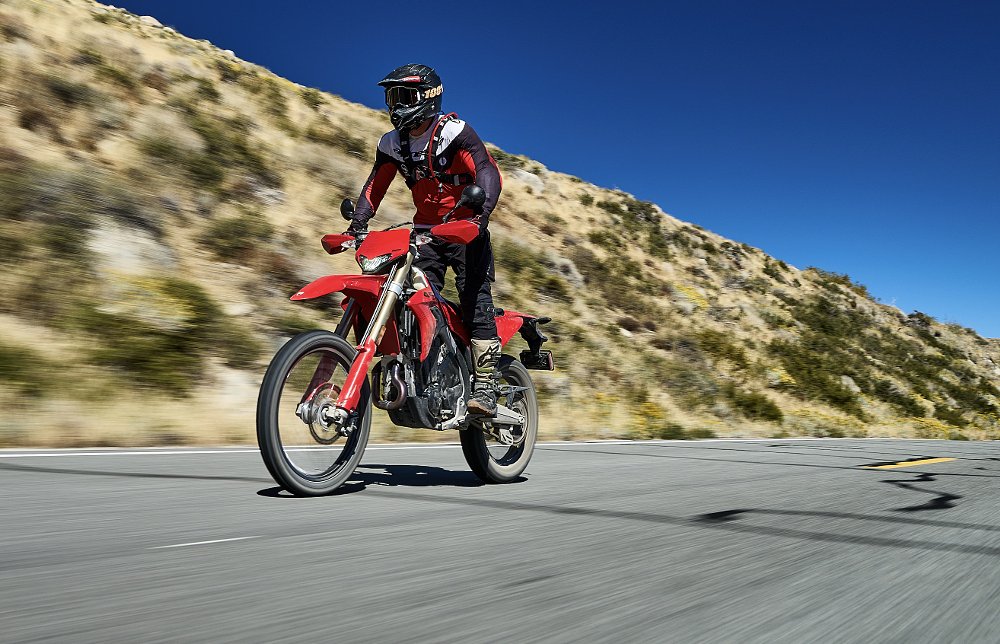
It all adds up to a claimed 42 horsepower and 33 foot-pounds of torque. If you’re a highly skilled rider who needs more oomph to splatter over three-foot boulders or you simply like bigger numbers, there’s quite a bit more power available with one of three DP (Ducati Performance) packages, but we’ll discuss those later.
Complementing the engine’s changes, the EDS’s fully adjustable Showa suspension is also relaxed. There are about 12 inches of travel at each end, controlled by softer springs and lighter valving. The update is supposed to provide a more compliant and comfortable ride and adapt the bike to the pavement travel, fast forest roads, and technical single-track that constitute the typical dual-sport diet.
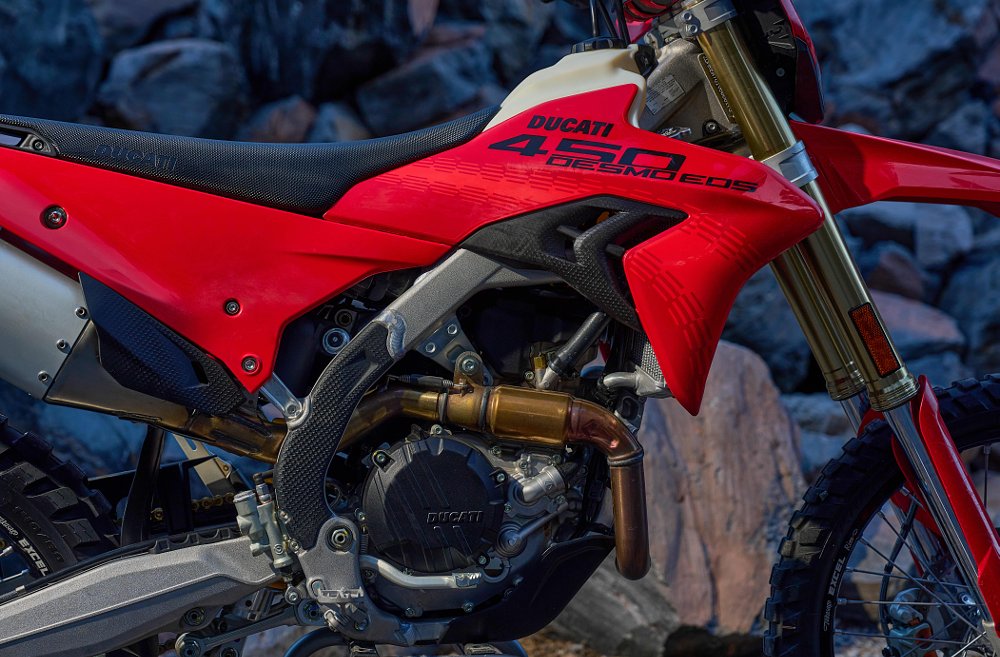
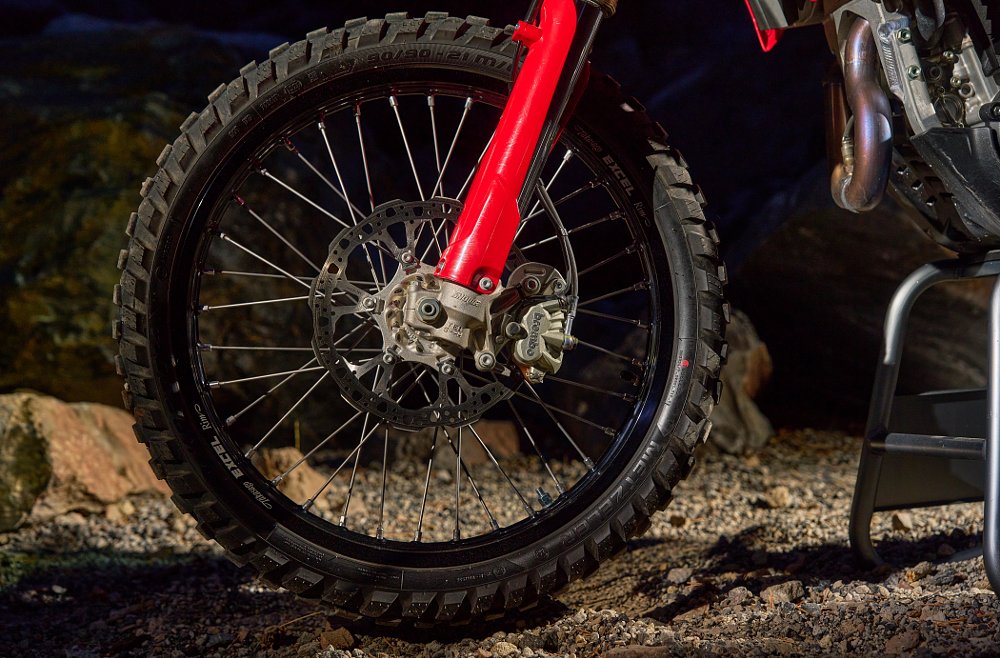
Everything is bolted to a beautifully welded aluminum frame composed of cast, forged, and extruded parts. The coarse-textured seat is taller than most at 38.2 inches, and the 2.25-gallon tank is larger than most, even if it sounds tiny by street bike standards. Wheels are a status quo 21-inch front, 18-inch rear combo, shod with 50/50 Mezteler Karoo 4 tires. All told, it’s a $12,995, 277-pound (wet, estimated) package designed to do what has become my favorite two-wheeled pastime: explore the great outdoors while challenging yourself with tricky terrain, all while indulging in frequent wheelies and power slides.
Riding the Italian enduro
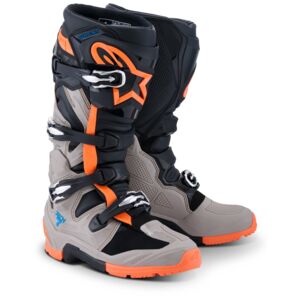
To experience the first Ducati dual-sport in half a century, Ducati invited us to Mammoth Lakes, California, high in the Sierra Nevada. At five feet, 11 inches tall with a 32-inch inseam, getting onto the Desmo’s seat required an actual jump. The bike may be narrow between your knees and allow your legs to fall straight to the ground, but I was balancing on the toes of my Tech 7s whenever I stopped.
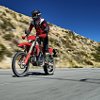
Even after sitting through a presentation that outlined how the EDS was designed to offer a high level of performance in a composed and controllable package, I still expected it to be hard-edged and difficult to ride, with an aggressive engine and stiff chassis. I was wrong. Rolling out of our fancy resort hotel and onto loose pumice trails outside of town, everything (except the seat) felt gentler than anticipated.
Throttle response and fueling were excellent, with no hint of the hesitation or abruptness that often plagues EPA-compliant bikes, especially high-compression ones. Then again, overall thrust felt muted, which makes sense. At 7,500 feet of elevation the engine was forfeiting some 20 percent of its output due to low air density, so we were likely working with a little over 30 ponies at the rear wheel.
Still, the low-end tractability was impressive. Torque is smeared on thick and smooth, just like the peanut butter I put on my kids’ toast. The Desmo pulls cleanly from just off idle and steadily builds steam until about 7,500 rpm, where you can feel it nose over. That rpm equates to around 100 mph in sixth gear, which is to say the power and transmission ratios are well matched. Cruising at a more socially acceptable 70 mph puts you at 6,300 rpm, with noticeable and irritating (but normal for the class) vibes in the seat and bars.
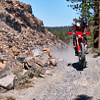
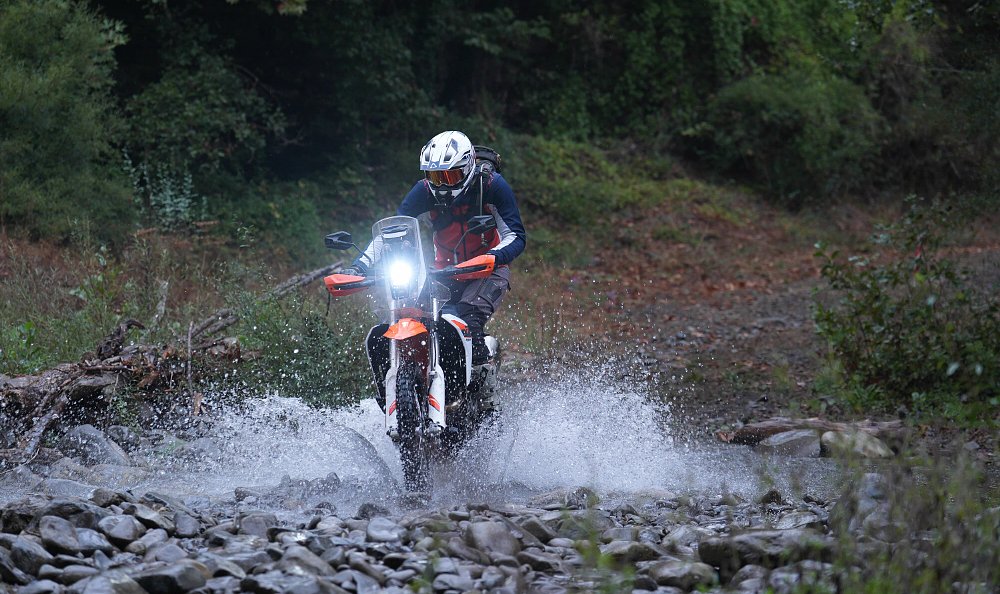
It’s been dry in the Sierra, and the forest roads around Mammoth see a lot of side-by-side traffic, which means the pumice is soft and deep in many places. Running a gear high and lugging the engine actually helped get through some of the deeper sections, since spinning the engine up would just trench the rear tire. Later in the day, while passing through a quiet mountain town, I let the revs fall in fifth gear, and the engine was happy to troll along at 25 mph and chug up cleanly from as low as 3,000 rpm. For a brand that built its reputation on V-, err, L-twins, Ducati designed a heckuva single.
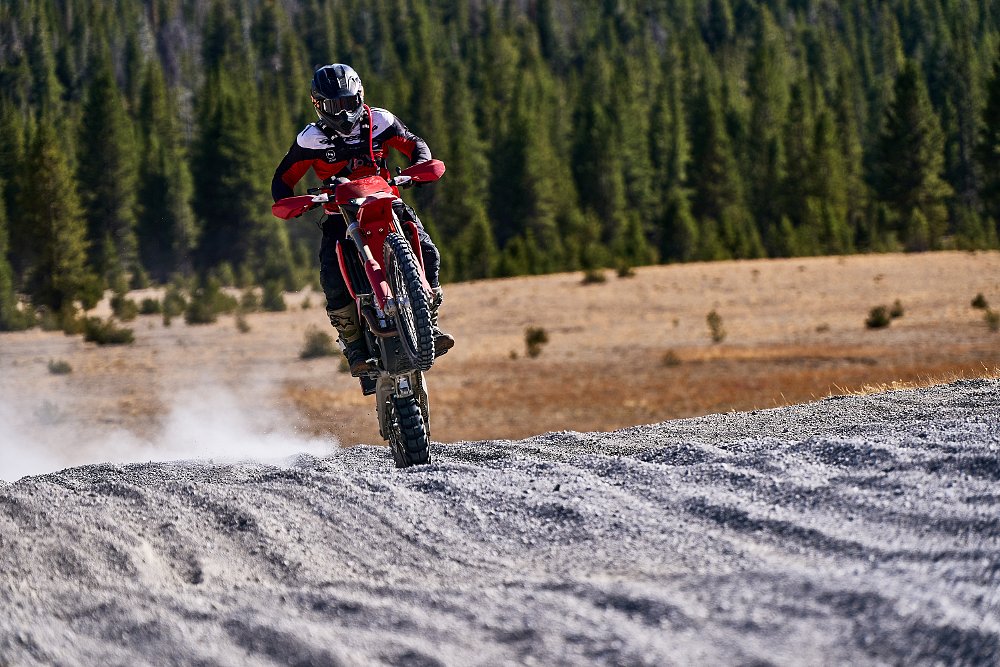
What most surprised me about the bike was the suspension setup. It’s plush without being soggy, supportive and stable without being harsh. I especially appreciated the way the fork managed the hard-edged rocks and roots sticking up in the trail. I braced for the front wheel to deflect and the grips to twitch in my palms, but the wheel just moved up and over the obstacles, leaving the handlebar and chassis unfazed. In time, I even allowed myself to hit these kinds of bumps while turning, leaning over, and braking. My first editor in the motorcycle industry told me to “never trust the front end off road,” but the EDS defies that advice, even with a not-so-great 50/50 tire limiting grip.
You can feel the suspension using a lot of its stroke, but it never bottomed. At 180 pounds (likely 200 in gear), the setup felt just about perfect for me on that terrain. A heavier or faster rider, or rougher trails, would likely warrant some damping adjustments and maybe higher-rate springs, but as a baseline setup it’s impressively compliant and stable. I know from experience that kind of disposition allows you to relax more, which alleviates arm pump and fatigue so you can ride longer.
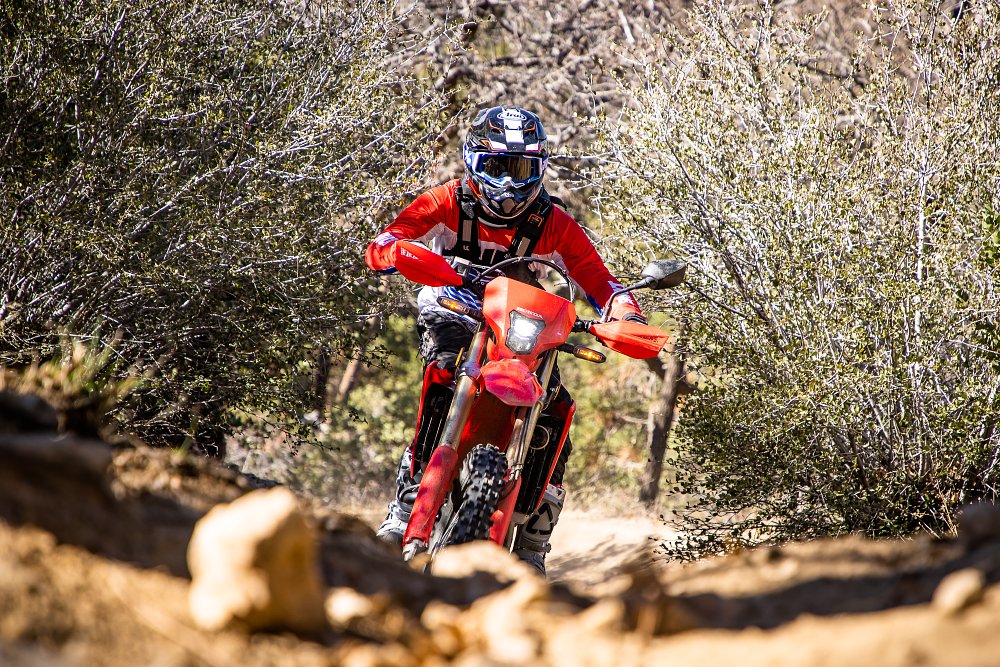
After 50 or so miles of sandy two-track, our group turned into the woods onto a ribbon of trail that threaded through the forest and around granite boulders. It was a welcome change of pace and a great opportunity to feel how the EDS carries its weight in tighter terrain and handles compound inputs. I wasn’t disappointed. I exited the woods with a big, dusty grin on my face and a real appreciation for the bike Ducati has built.
The Ducati difference
Coming out of the gate with a competitive, refined enduro like the EDS is impressive. What’s equally cool is that it’s not just a me-too machine. There are a number of unique technologies and features that differentiate this bike — if you’re willing to pay, and compromise your bike’s homologated status.
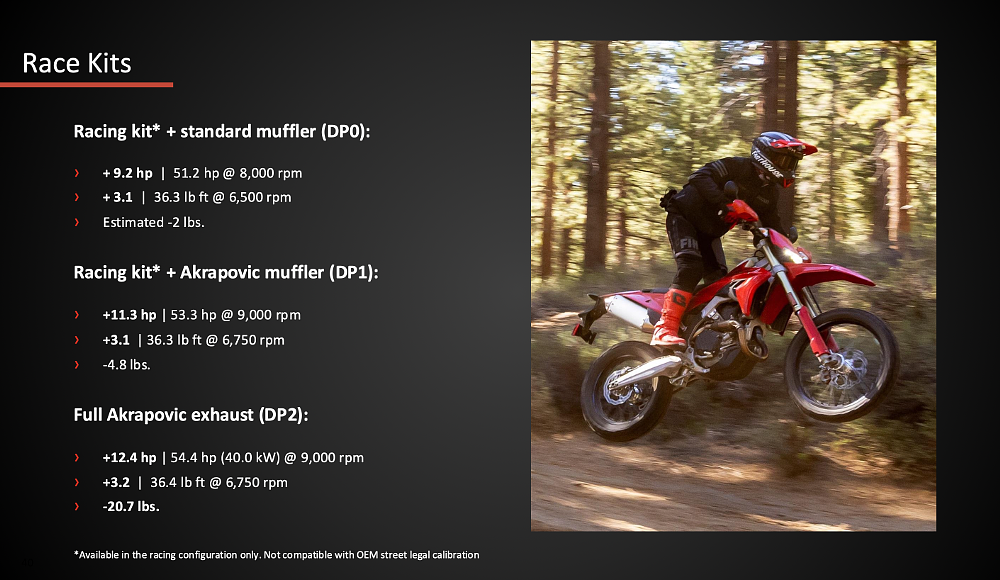
I’m referring to the DP0 (Ducati Performance Zero) kit, as well as the higher DP1 and DP2 options, all of which constitute a “race configuration," i.e., no longer street-legal. DP0 is just $261, and adds nine horsepower and three foot-pounds of torque by way of an exhaust header, intake, and ECU flash.
DP0 also unlocks multi-level traction control, a quickshifter, launch control, variable engine braking, and switchable engine maps, all controlled via an add-on handlebar switch. That’s a low, low price for a lot of features. Other brands offer exhausts and ECU flashes, but this level of electronics on an enduro is unprecedented, especially within the OEM ecosystem.
Throw another $200 at the bike for the Wi-Fi module and you can manage the DP0 settings from your phone, as well as access what Ducati is calling Predictive Maintenance. This is a feature that really stands out to me, since the service schedule for off-road equipment, which is determined by a combination of hours of use and intensity of use, is so dang subjective.
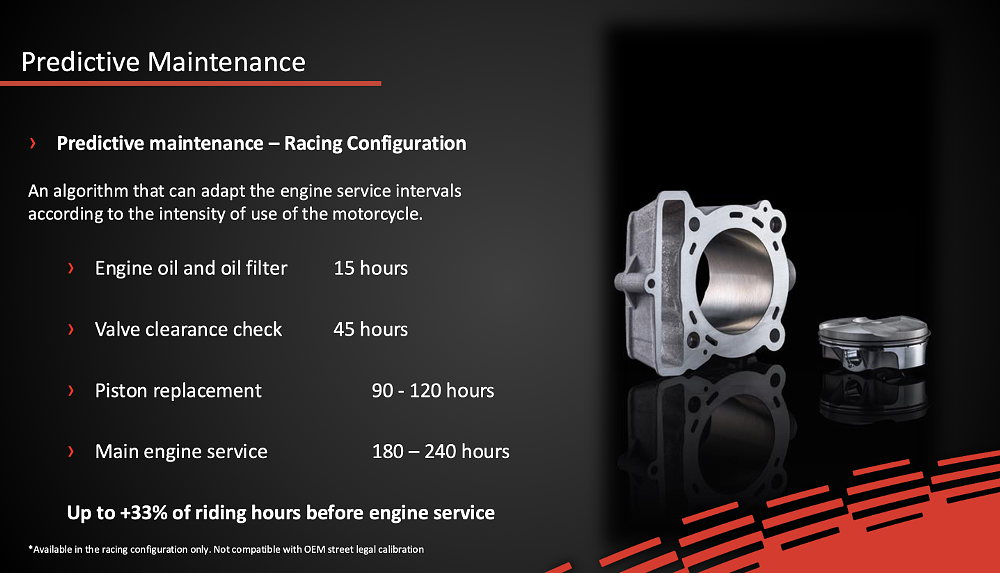
Using algorithms developed in MotoGP, the ECU monitors parameters like throttle angle, rpm, coolant temp, and more to extrapolate when you should check the valve clearances, replace the piston, or tackle a full rebuild. Predictive Maintenance erases a huge question mark that hangs over the “intensity” factor in a bike’s maintenance program, and Ducati says it can extend riding time by up to 33 percent.
As a guy who’s proactive with maintenance but also frugal with my time and money, Predictive Maintenance inspires a lot more confidence than rolling the dice based on anecdotes and opinions found on user forums.
Complaints… and the competition
With that, we’ve reached the end of my compliments, which means it’s time for some critiques.
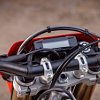
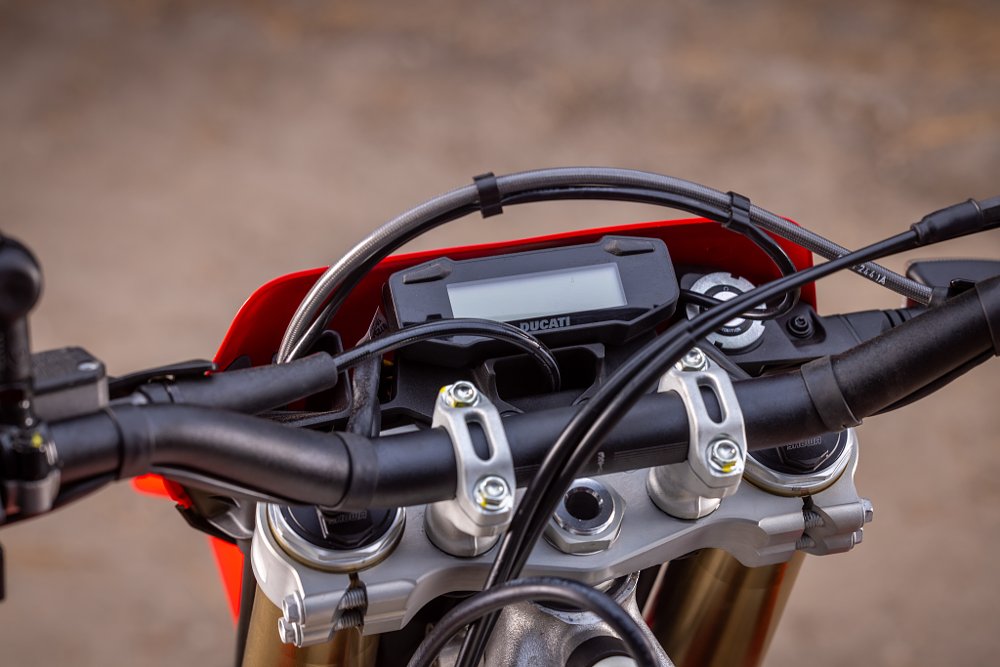
While it’s odd to see such a small, simple LCD dash on a Ducati, it’s status quo for the class and gets the job done. What I don’t like is that it shuts off with the engine. Same for the radiator fan. This is surely to protect the lithium-ion battery’s charge, but it means any interactions with the dash have to be done with the engine running. That means wasting precious minims (that’s 1/480 of a fluid ounce — the imperial system is so ridiculous) out of your 2.25-gallon payload.
Next up, is that thing way, way up there. I’m talking about the seat. Boy howdy, 38.2 inches is not for the short of inseam, and if you intend to swap it out for something more comfortable, you’ll no doubt be adding padding, and thus height.
Finally, the mirrors proved to be a bit of a disappointment. They shake on road and break off road. The pivoting design is clever in theory, but the stalks are too flimsy for enduro life.
And if you’re into that enduro life, then the Desmo450 EDS is an enticing new alternative to the three machines I alluded to in the intro, which are the KTM 500 EXC-F, Husqvarna FE 501S, and Honda CRF450RL.
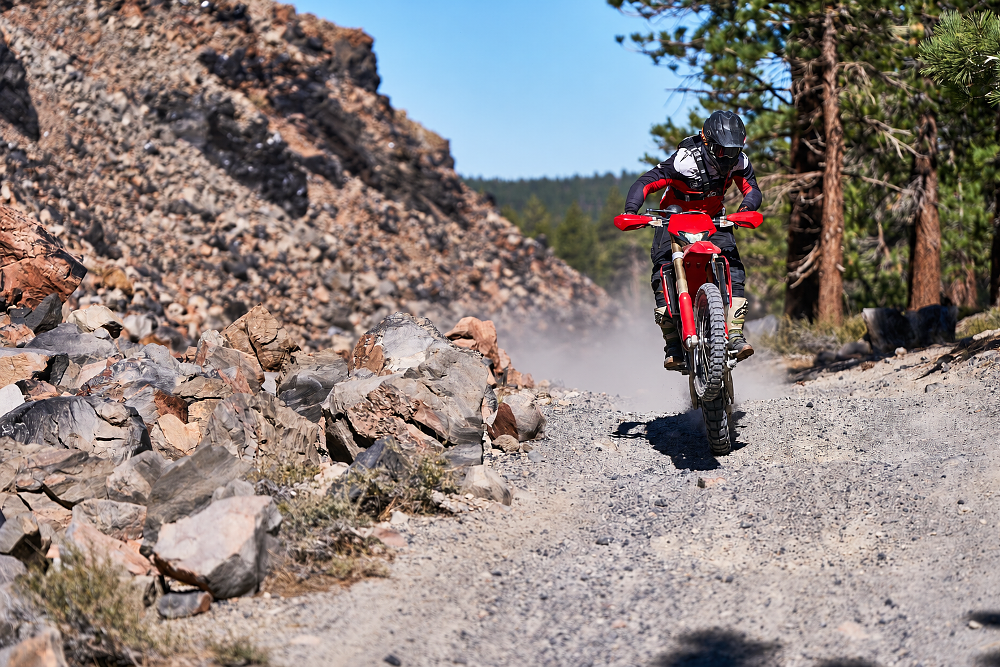
The Desmo450 EDS is, in my humble and not especially experienced (as an off-roader) opinion, fully competitive with those bikes in all respects. Spec-wise, I’d say it’s a matter of preference, and I prefer the softer suspension (read: less deflect-prone) of the Ducati. Price-wise, there is a substantial delta between the (heavier, stall-prone) $10,099 CRF and the $12,995 EDS, but a much smaller gap for the proven and extremely popular $13,499 EXC-F and $13,599 FE 501S.
Where there were three, there are now four, which means Ducati brought us a 33 percent increase in the number of choices for folks who want a dirt bike with lights. So, will the EDS become the new go-to in the high-performance dual-sport market? It’s hard to say, but it’s certainly an impressive way to return to the category after a half century away.
| 2027 Ducati Desmo450 EDS | |
|---|---|
| Price (MSRP) | $12,995 |
| Engine | 450 cc, liquid-cooled, four-valve, single |
|
Transmission, final drive |
Six-speed, chain |
| Claimed horsepower | 42.0 @ 6,750 rpm |
| Claimed torque | 33.0 foot-pounds @ 5,750 rpm |
| Frame | Aluminum twin-spar |
| Front suspension | Showa 49 mm fork, adjustable for rebound and compression damping; 12.2 inches of travel |
| Rear suspension | Showa Sock, adjustable for preload, rebound and compression damping; 11.9 inches of travel |
| Front brake | Brembo two-piston caliper, 260mm disc |
| Rear brake | Brembo single-piston caliper, 240mm disc |
| Rake, trail | 27.3 degrees, 4.6 inches |
| Wheelbase | 58.8 inches |
| Seat height | 38.2 inches |
| Fuel capacity | 2.2 gallons |
| Tires | Metzeler Karoo 4, 90/90-21 front, 140/80-18 rear |
| Claimed wet weight | 277 pounds |
| Available | Now |
| Warranty | Six months or 40 hours |
| More info | ducati.com |