

 Membership
 Riders Preferred Membership
 Shop by Vehicle
 Track Order
 Contact Us
Bologna Italy is famously famous (as the saying goes) for the three Ts: torri, tortellini, and tette (for the towers, the foods, and the nymphs on the statues). Additionally, it has the oldest university in Europe (established 1088), has exquisite examples of medieval architecture, and its unfinished cathedral has a solar calendar built into the floor which channels a sunbeam from the ceiling to a line on the floor that illuminates the date.
Four miles west is Borgo Panigale, which is famous for its radio capacitor and office equipment manufacturer that turned to motorcycles: Ducati. Borgo Panigale translates to "the village where millet/panic grass grows."
Now, sometimes studying Italian is enlightening and it's wonderful to learn how the language blends with the history and culture and how Italy invented Western Civilization. Twice. Other times you figure out that Ducati named its premier sport bike Panic Grass.
Italy being Italy, 90 minutes east of Bologna is the Misano World Circuit Marco Simoncelli, 90 minutes west of Bologna is the Cremona Circuit Angelo Bergamonti, 60 minutes south is the Mugello Circuit, and then Modena has two more tracks: a Ferrari test track and the small local circuit the Autodromo di Modena, which Ducati rented for the press launch of the new 2026 Hypermotard V2 SP.
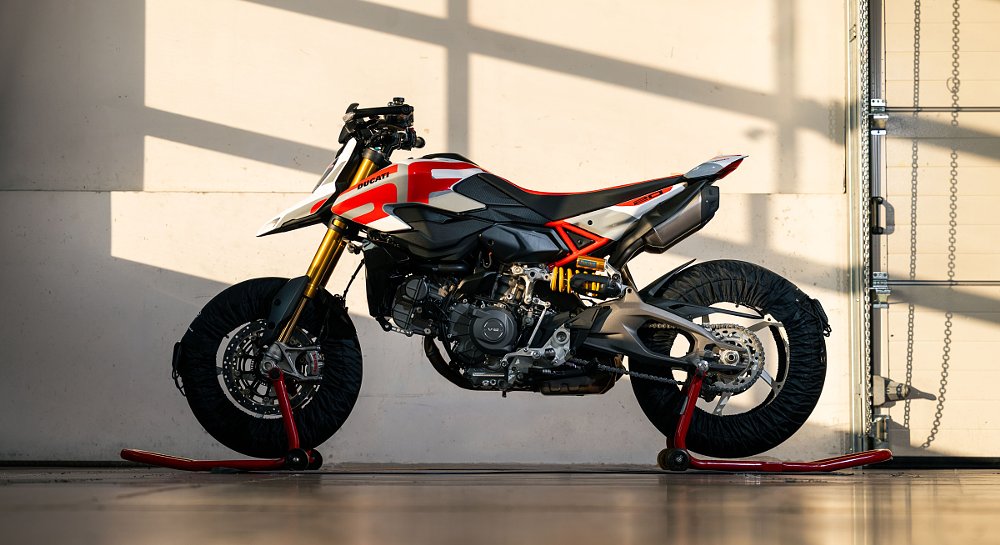
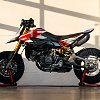
While Ducati is celebrating its 100-year anniversary this year, the Hypermotard is now turning 20! Introduced as a mighty 1100 cc before morphing through 821 cc and 950 cc versions, we are now on the fourth version at 890 cc.
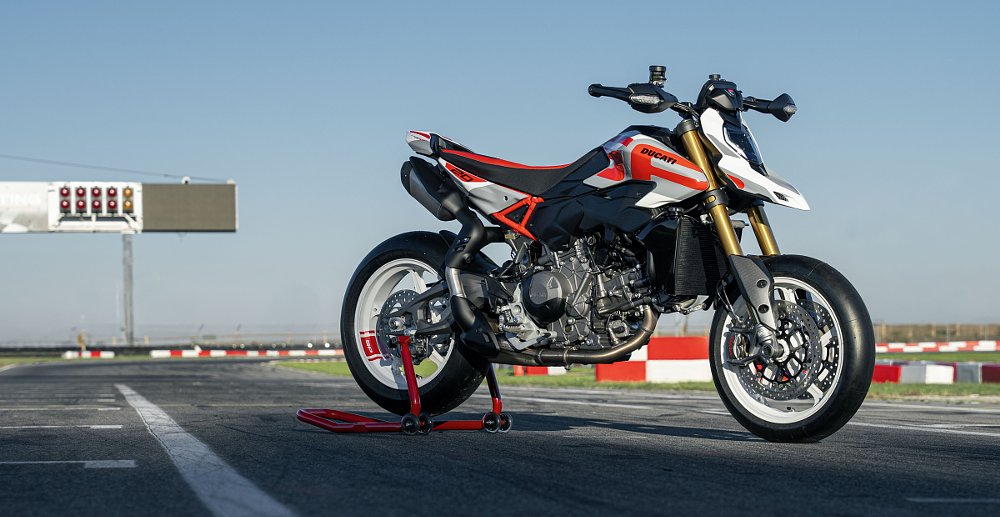
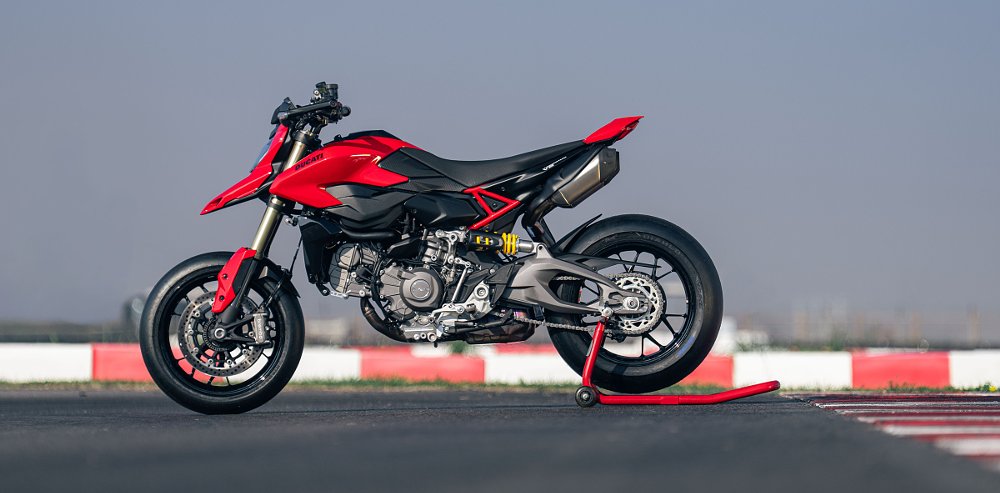
The 2026 Hypermotard V2 SP is a whopping 31 pounds lighter than the 950 model. The V2 engine is the lightest twin-cylinder engine Ducati has ever built and is 6.42 kilograms (14.2 pounds) lighter than the previous "Testastretta" engine. The aluminum monocoque frame reduces weight by 4.6 kilograms (10.1 pounds) over its predecessor and is not shared with other V Due models.
Taking the Hypermotard V2 SP to the track
The Hypermotard is a joyful motorcycle. There are faster track bikes, there are more stylish street bikes, and there are more comfortable touring bikes, but there is nothing else that is quite as light and punchy. You can rock this form factor on the chewed-up back roads and potholed city streets that we have, not the billiard-table-smooth pavement of our dreams. The low footpegs and high handlebar make the seating position pretty comfortable and the narrow seat, which would become intrusive on a long ride, is rendered moot by the range limits of a 3.3-gallon gas tank.
The bike would be a natural fit for the cobblestones of downtown Bologna as well as the exquisite Apennine mountain roads just to the south, like the Passo della Futa. However, increased police presence on the local mountain roads encouraged Ducati to rent the race track for us instead of having to help us navigate the Amanda Knox version of Italian traffic enforcement.
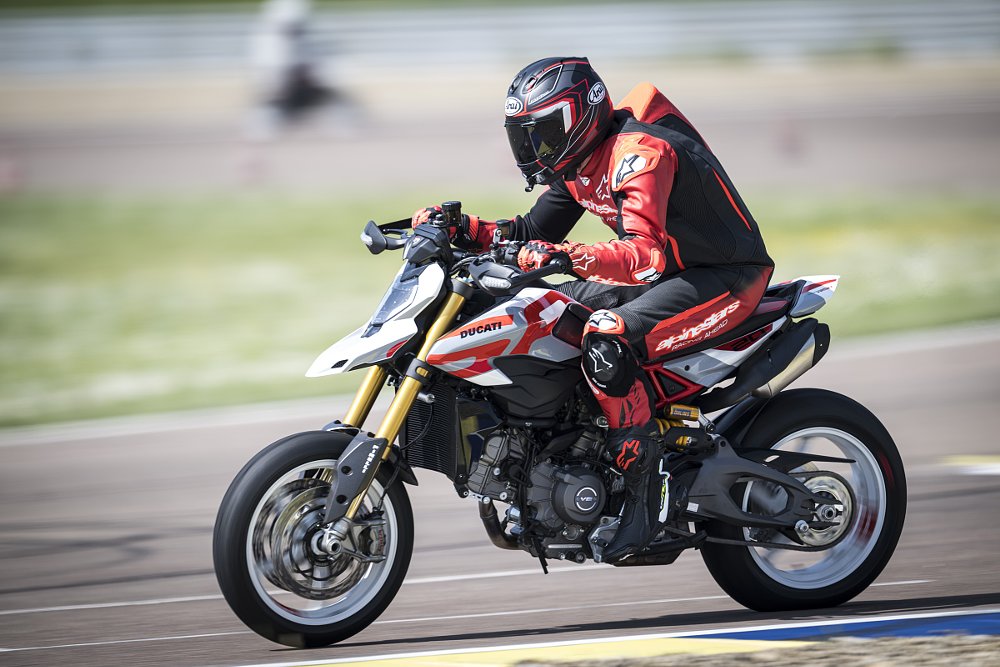
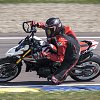
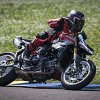
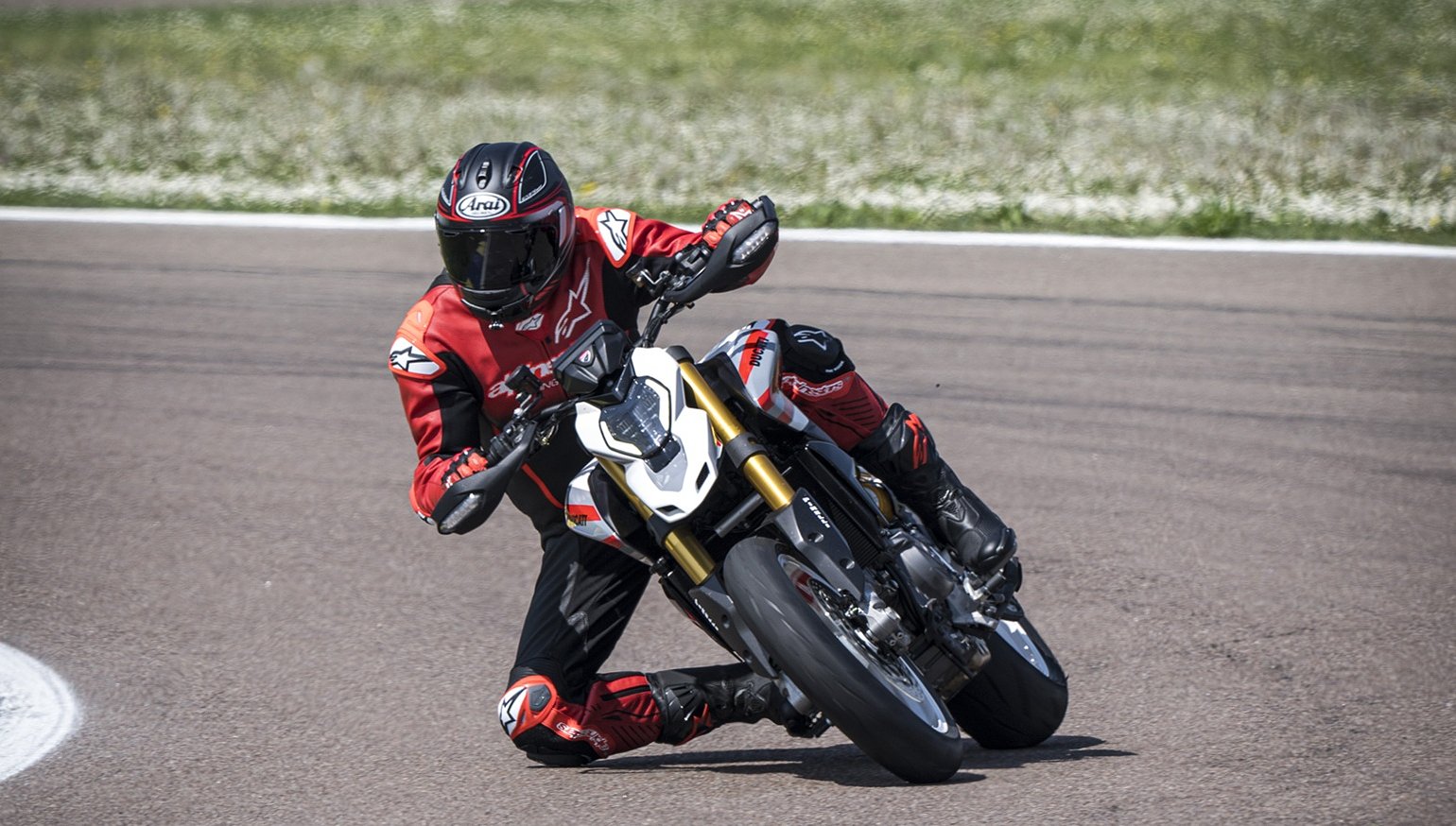
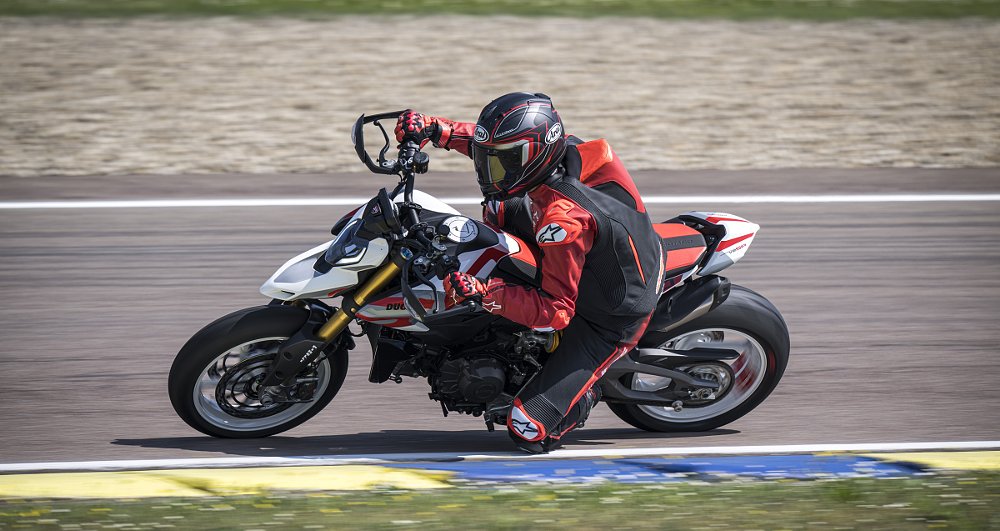
The Autodromo di Modena is a tight track with mostly second-gear turns arranged into a series of three omegas with lots of decreasing-radius exits and small camber changes. On paper, the Hypermotard has conservative, pro-stability steering geometry, but with its light weight, wide handlebar, and forged rims, the SP was so nimble that I had to relax a little on my corner entries. It could change direction so quickly that I had to steer a little to stay off the inside curbing. That quick steering would be ideal for dodging small wildlife on country roads.
On the track, the downside of the comfortably low footpegs is they become the limiting factor. Enter a turn on your knee and keep turning until the peg grinds. The Pirelli Diablo Rosso IV Corsa tires and Öhlins suspension generated so much mechanical grip that even the peg hits didn't really upset the bike. They just served as a heuristic warning of physical limitations. On a street ride, I seriously doubt I would touch down the pegs.
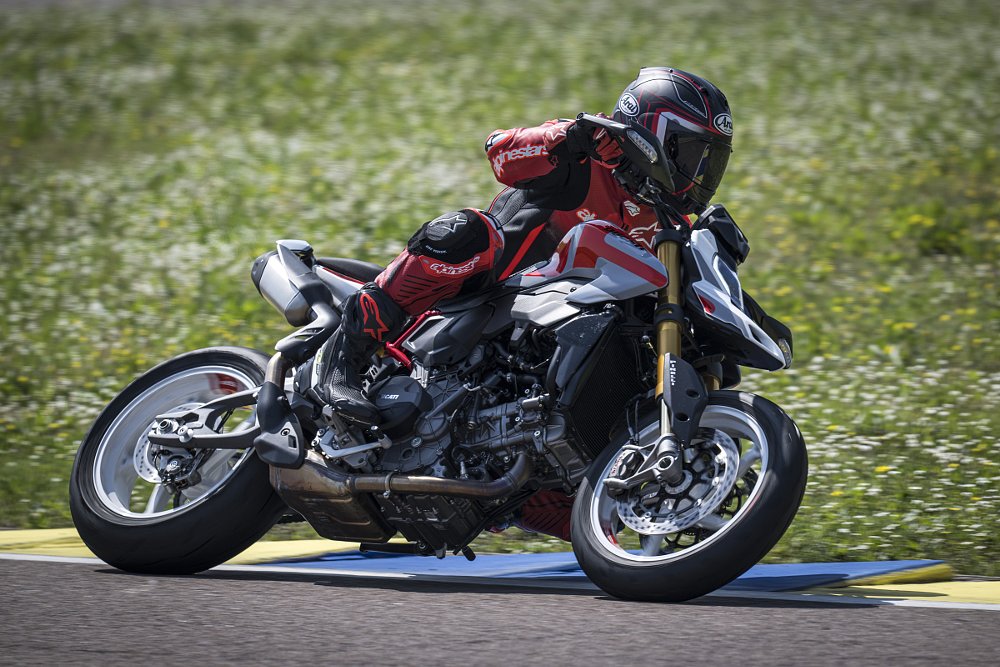
The circuit surface was smooth by U.S. standards and rough by European standards. The Öhlins fork and shock would cross all the ridges, cracks, and holes with nary a bobble. The Brembo brakes fore and aft are all very high specification and, given the bike's light weight, were more than up to the task. This being a Hypermotard, the ABS can be configured to disable the rear ABS entirely (the most fun but hardest on rear tires) or the rider-assist mode that allows you to lock the rear but the ABS will take over brake modulation again if the bike incurs too much yaw or leans over past 35 degrees. Burn-outs will fault the traction control and ABS system but, in the interest of science, I did test that the bike will allow them.
On the new Hypermotard V2, Ducati has installed a sophisticated six-axis Inertial Monitoring Unit (IMU) which is a digital gyro that tracks roll, pitch, and yaw in real time. The IMU and wheel-speed sensors combine with all rest of the data flowing over the motorcycle's CANBUS network to conduct a symphony of electronic aids.
The Hypermotard is equipped with four riding modes (Race, Sport, Road, and Wet) but each can be customized to adjust traction control, wheelie control, ABS, and engine braking. Since we were on the track, I usually ran the bike in "Race" mode with full power, a bit of traction control, no wheelie control, limited engine braking, and rear ABS disabled. Most of the time I was only using the rear brake slides to peacock and I let the slipper clutch and electronic back torque limiter handle the rear wheel at corner entrance if I was trying to turn a quick lap. For those of us who still want to act a fool, the "Slide by Brake" function in the Level 2 ABS setting acts like a digital coach, helping you back it into corners like a Supermotard pro without the highside trip to the ER.
Wheelie control settings can either keep the front wheel on the tarmac or allow about 14 inches of lift, or it can be turned off entirely. With the wheelie control off, the bike's torquey engine, light weight, and high handlebar encourage power lifts at every opportunity.
All this wizardry is funneled through a high-res five-inch TFT dash that ditches the clutter for three distinct "Info Modes." And, if you opt for the SP, you get the full "factory racer" starter pack, which includes the Pit Limiter and Power Launch, straight out of the crate.
The V2 engine is smooth and though the play in the rubber-mounted handlebar is just barely discernable, there was basically no vibration in the grips or footpegs, even with the rubber inserts removed from the pegs to expose the higher grip, and welcome, peg teeth.
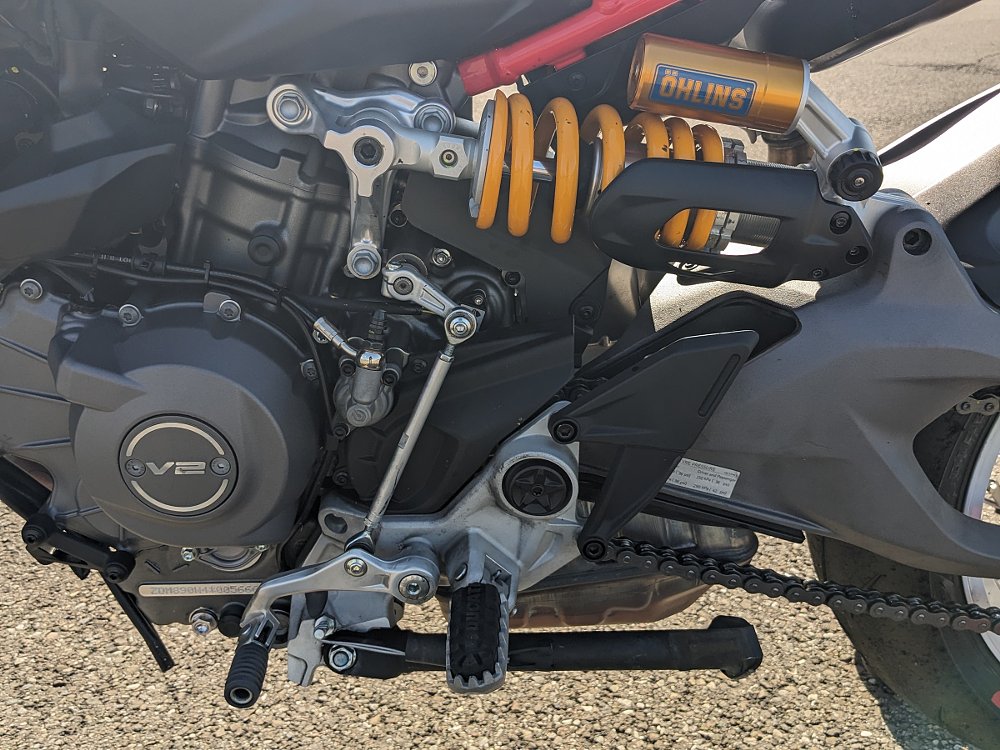
I was not the only one in our test group to have a few glitches with the quickshifter on the Hypermotard V2 SP. I would periodically have momentary abrupt power loss after shifts which felt like hitting the rev limiter, except I wasn't anywhere near the redline. It was disconcerting. The Ducati uses an internal transmission sensor for its quickshifter while most bikes use a linear potentiometer in the shift linkage. The shift lever has a bulky design, which could result in unintentional boot contact, so maybe it was me hitting the lever slightly causing the power loss (which is a design flaw either way), but I was far from the only rider having the power interruption issue that day. I didn’t have a CANBUS data recorder on the bike but maybe it was happening more if I was at 95% throttle instead of 100% throttle, or maybe it was better if I rolled the throttle open rather than staying at 100%, but the unpredictability took some of the joy out of a lap and certainly made me reluctant to ride close to anyone else. A similar issue was noted in Melissa Berkoff's review of the 2026 Ducati Monster+, so maybe there is an ECU mapping issue that could use a little attention. The other 99.9% of the time, the engine fueling was spot on and, particularly, the first touch of the throttle, in second gear, with the footpeg scratching the pavement, was smooth and confidence-inspiring.
A deeper dive inside the V2 engine
When I was first learning about tuning motorcycle engines, I imagined that air flowed in through the intake and out the exhaust, and that was kind of the whole thing. The first time I was in a dyno room watching a Yamaha FZR400 be revved to 14,000 rpm without the air box lid on, I saw a massive cumulus cloud of vaporized gasoline form over the motorcycle at various RPMs, and then subsequently disappear!
Back then, we had these magical texts that held the secrets of the universe. They were called "books." And one of the best ones was "Tuning For Speed" by Phil Irving. He was the genius Australian engine designer behind the Vincent Black Lightning, and he wrote down all his tuning numbers in the book. Since the speed of sound is still holding steady (I mean, depending on altitude and density of medium, but you get my point) his book is still a great read.
What we learned is that in performance motorcycle engines, you have all these energy waves bouncing around in the exhaust and intake tracts. These move at the speed of sound and are triggered by things like port size changes, valves opening and closing, and the ends of velocity stacks or exhaust pipes. Most broad-range-rpm motorcycle engines are going to go through two resonant periods where the energy waves are in or out of phase. In bikes with carburetors, when the wave is out of phase the air moves backwards through the carburetor, enriching it again and forming a cloud of gasoline over the bike if you are in a dyno room. Then the piston pulls that air back through the carb a third time, giving you the dreaded triple enrichment. Fuel injection allows us to control for triple carburation, but the energy waves remain, and, with good engineering, they are the fun part of motorcycle engines.
Remember, everything in the engine takes time, and at high rpm you have less time for things to happen like "combustion" or "filling the cylinder with a fuel-air mixture." For high performance, you really want the intake valves opening while the exhaust valve is still open so the departing exhaust gases pull the intake gas into the cylinder and then start flowing out the exhaust port, which is called "cam overlap." You want the energy wave in the exhaust pipe to come back to the exhaust port at just the right time to push that intake gas back into the cylinder, giving you more fuel in the combustion chamber for the next pulse.
The problem with all this is that you have to choose what rpm you want for your power and, for every, say, 3% at peak, you give up 7% down low, where things are all lumpy and out of phase. Enter variable length intake tracts and, most relevantly to this Hypermotard, variable intake valve timing.
To get that sweet, sweet cam overlap, you really want to open and close the valves as fast as possible. The problem with that is the whole "materials failure limits" and other tradeoffs. With a traditional cam, the valve has to follow the profile of the cam lobe. The valve spring needs to be strong enough not to let the valve "float" off the ramp of the cam (particularly at high rpm) or, worse, bounce on the valve seat when it lands (like lots of downshifts and dumping the clutch). And, to make matters worse, the stiffer the valve springs, the more internal friction you have in the engine.
Ducati famously used desmodromics for their valve trains, which incorporates mechanical cams to both open and close the valves. Eliminating valve springs allows for very aggressive cam profiles, lots of overlap, and low internal friction. Life was good… until you had to change the cam belts or reshim the clearances, or the rocker arm hard coating delaminated.
But then there was this whole EU thing, Italy lost a lot of its independence, and the Italians had to fight with Brussels about wood-fired pizza ovens, and formaggio con i vermi, and the EU passed Euro 5 and then Euro 5+ emission standards. Those regulations so dramatically reduced the acceptable unburnt hydrocarbon emissions that it forced a lot of engine designers to ease back on the cam overlap to keep the unburnt fuel out of the pipe. Less overlap means less aggressive cam profiles which means desmodromic complexity becomes less justified.
But, just as the Italians will still fight for your right to eat cheese with maggots in it, your friends in Bologna didn't abandon affordable cam overlap!
Enter the Intake Variable Timing (IVT). Ducati uses pressurized oil and ECU control to swing the intake cam on its drive sprocket 26 degrees (cam, not crank, degrees) from low rpm to high rpm. Anyone who has ever degreed a cam will read that with a WTF!!!??? moment because 26 degrees is kind of like installing the cam two teeth off! That usually results in bent valves. But in this case, the valve detents in the pistons and the cam lifts are all set up so that the intake cam can run advanced timing at low rpm, which means it opens sooner and, more importantly, closes sooner, so there is less overlap at low and medium rpm. Then, at high rpm, the intake cam retards to close later, which gives us Euro 5+ approved cam overlap we love so much.
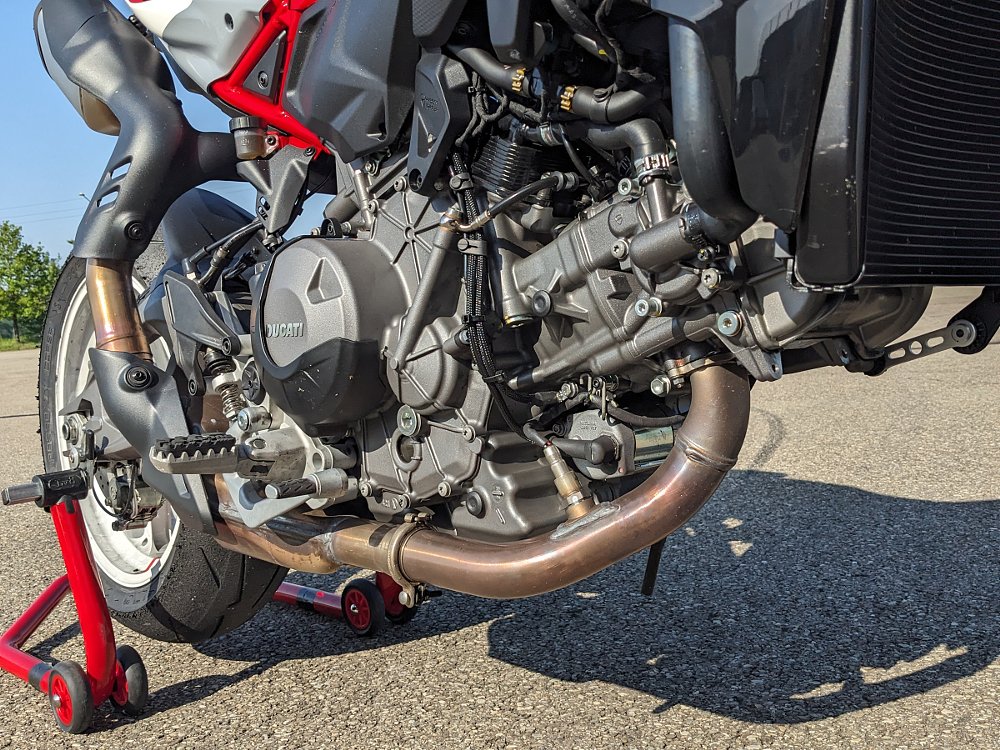
All this is to say that given the complexity of the regulations and economic considerations, Ducati has done a great job in releasing a 120-horsepower engine with low maintenance (28,000-mile valve clearance intervals and 9,000-mile oil service), smooth fueling and fun cam overlap that gives a great rider experience — as long as the quickshifter doesn't glitch.
Hypermotard V2 versus V2 SP
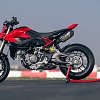
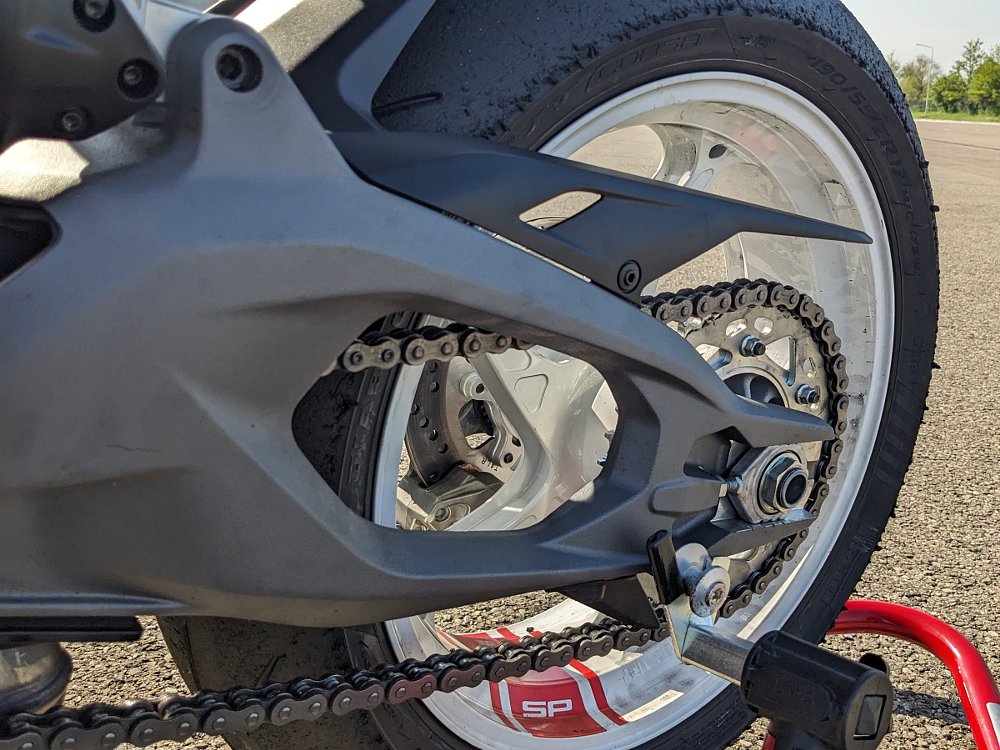
The primary differences between the Hypermotard V2 and the Hypermotard V2 SP lie in their chassis components and handling hardware. While the standard V2 is equipped with a 46 mm Kayaba front fork and an adjustable Kayaba rear shock, the SP model features a premium, fully adjustable 48 mm Öhlins fork and an Öhlins rear shock absorber. The SP is upgraded with Brembo Monobloc M50 four-piston calipers, offering higher performance than the Brembo Monobloc M4.32 calipers found on the standard model. The wheels and tires are also upgraded on the SP; it utilizes forged aluminum wheels instead of the base model's cast light alloy wheels and is fitted with track-focused Pirelli Diablo Rosso IV Corsa tires rather than the standard Pirelli Diablo Rosso IV rubber.
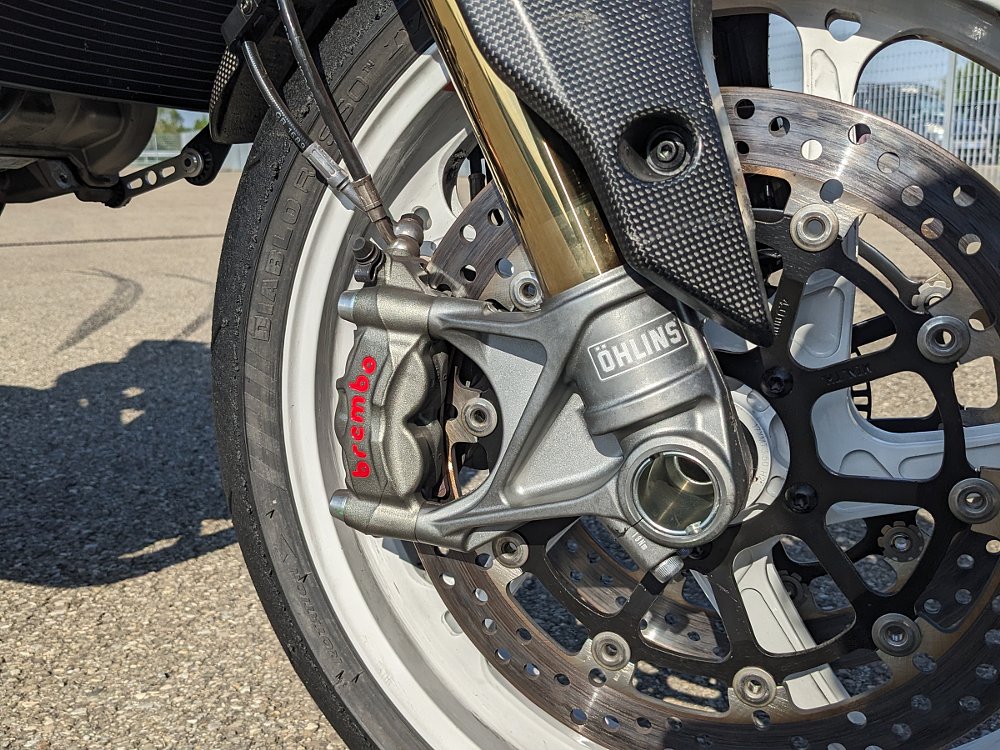
Cast rims are made from poured molten aluminum which results in a more random metal grain. Casting requires more material to achieve strength, so they are heavier, but less expensive. Forging involves hot metal blanks smushed in a giant press. This aligns the grain in a uniform fashion so you can use less metal and get a lighter rim. It's a more complicated process so the forged rims are more expensive.
Lighter rims solve so many handling issues! A better sprung-to-unsprung-weight ratio (weight over the springs versus weight below the springs) means better bump tracking, but the big difference is that lighter rims mean less centrifugal effect. When you push on the handgrip one way your front rotating mass tries to push back the other way at 90 degrees, but the lighter the rims, the less force you need to overcome. At higher speeds, more inertia is involved, so while on the street it's not a big deal, on the track it's noticeable. I usually just ask myself, on my death bed, surrounded by my loved ones, will I be thinking, "I'm glad I bought the cheaper rims."
By incorporating forged wheels, a lithium-ion battery, and a carbon fiber front mudguard, the SP reduces its wet weight (without fuel) to 390 pounds (177 kilograms), which is seven pounds lighter than the standard V2.
Both bikes share the same core engine performance, but the SP comes standard with Ducati Power Launch (DPL) and a Pit Limiter, features that the standard V2 is "ready for" but does not include out of the box.
U.S. MSRP on the standard V2 is $16,995 and the SP model is $20,995.
| 2026 Ducati Hypermotard V2 SP | |
|---|---|
| Price (MSRP) | $20,995 |
| Engine | 890 cc, liquid-cooled, eight-valve, V-twin |
|
Transmission, final drive |
Six-speed, chain |
| Claimed horsepower | 120.4 @ 10,750 rpm |
| Claimed torque | 69 foot-pounds @ 8,250 rpm |
| Frame | Monocoque aluminum |
| Front suspension | Öhlins 48 mm fork, adjustable for preload, rebound and compression damping; 6.7 inches of travel |
| Rear suspension | Öhlins shock, adjustable for preload, rebound and compression damping; 6.3 inches of travel |
| Front brake | Brembo Monobloc M50 four-piston calipers, dual 320 mm discs, with ABS |
| Rear brake | Two-piston caliper, 245 mm disc with ABS |
| Rake, trail | 26 degrees, 4.3 inches |
| Wheelbase | 59.6 inches |
| Seat height | 34.6 inches |
| Fuel capacity | 3.3 gallons |
| Tires | Pirelli Diablo Rosso IV Corsa, 120/70ZR17 front, 190/50ZR17 rear |
| Claimed weight | 390 pounds (no fuel) |
| Available | Now |
| Warranty | 24 months |
| More info | ducati.com |